
Autocallable ETFs have become a hot, exciting topic for income-focused investors. These funds provide a lot of stability, plus very attractive yields. Our team has taken the lead in explaining these funds to investors. Recently, VegaShares launched a second ETF in the category. One is more aggressive; the other is quite conservative. Let’s look at the risks and how they differ between the two funds.
Autocallable notes are interest-paying custom investments. A note pays interest as long as a designated asset or index meets certain criteria or levels. The notes in the VegaShares ETFs are linked to the S&P 500.

An autocallable note has four defining values. These values refer to the underlying index:
- If the index is above the coupon barrier (the specific threshold tied to the index), the note will pay its regular interest payments. If the index falls below the coupon barrier, interest payments stop until the index is again above the coupon barrier.
- The autocall barrier is an index level where the note will be automatically called if the index is above that level.
- Notes also have a non-call period, during which they cannot be called.
- The maturity barrier (also sometimes called the principal barrier) is an index level such that, if the index is below it when a note matures, the note will realize a loss equal to the decline in the index. For example, if a note has a 70% barrier, and the index is down less than 30% at maturity, it will pay off 100% of its value. If the index is down more than 30%, the note will get the same percentage loss as the index.
Let’s look at the portfolio characteristics of the VegaShares autocallable ETFs…
Here is the portfolio graphic for the VegaShares U.S. Equity Autocallable Income Fund (VAIE):
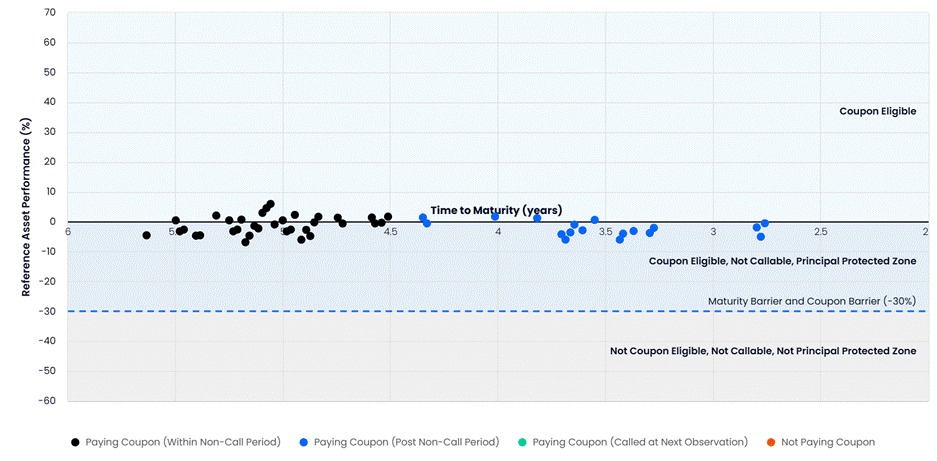
VAIE holds 52 notes. In this ETF, both the maturity barrier and the coupon barrier are a 30% decline. Each note has different barriers, based on the index value when the note was acquired. The VAIE portfolio has an average weighted coupon of 16.65%. The fund pays weekly dividends with a current yield of 16.61%.
Here is the portfolio holdings graphic for the Vegashares U.S. Equity Autocallable Conservative Income ETF (VAIC):
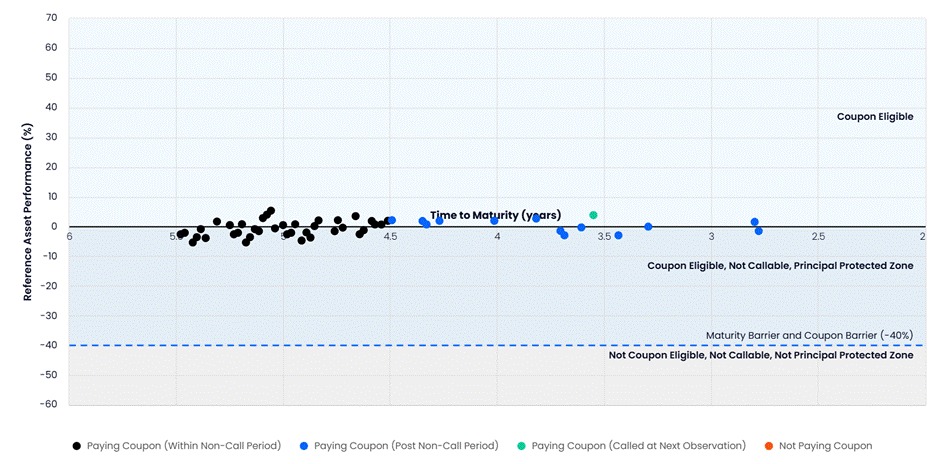
VAIC also holds 52 notes. You can see that the maturity and coupon barriers are at a 40% decline in the index. This is more conservative, because the index must fall farther for the notes to stop coupon payments or suffer losses at maturity.
The VAIC portfolio has an average weighted coupon of 9.17%. The fund launched on September 24, so it does not have a published distribution yield. It will be around 9.1% to 9.2%.
These two ETFs show how you can select risk to match your investing philosophy and earn an attractive yield based on the level you choose. In our ETF Income services, we cover and recommend autocallable ETFs for our subscribers.
Stop Trying to Pick AI Winners. Start Collecting AI Dividends Every Thursday.
Everyone wants to know which AI stocks are going to win. But you can invest in one fund that owns them all and collects up to $1,051 a month, delivered every Thursday. Watch Tim Plaehn's full briefing here.