
If you have followed my work for a while, you might have already heard the story I am about to share. I revisit it from time to time because history matters, especially when it comes to the markets in which old lessons have a way of resurfacing when conditions change.
There is a funny constant in the investing universe. Interest rates change. Markets panic. New technologies appear. Strategies go in and out of fashion. Yet you can Google Warren Buffett at almost any moment and find a fresh stack of headlines discussing something he said, something he bought, or something investors think he might do next.

When thinking of Buffett, I also often think of Ben Graham, a Columbia University business school professor whom Buffett studied under. Graham is credited with creating the discipline of value investing. He coauthored one of the first book on the subject with David Dodd.
Graham also wrote a book called The Intelligent Investor, which explains the process of investing. In that book, he wrote, “An investment operation is one which, upon thorough analysis, promises safety of principal and an adequate return. Operations not meeting these requirements are speculative.”
I believe this is a widely misinterpreted sentiment. Many investors believe Graham recommends long-term value investing as the key to success. But that’s not at all what he says.
The cornerstone of an investment operation is analysis. That could include an analysis of a company’s financial statements and a review of the long-term prospects of the company’s industry. But that’s all subject to change.
Many analysts pored over the financial statements of Bear Stearns in 2007 and viewed the stock favorably. I know many of you are newer investors and may not remember Bear Stearns, which crashed suddenly in 2008—much like Silicon Valley Bank did more recently.
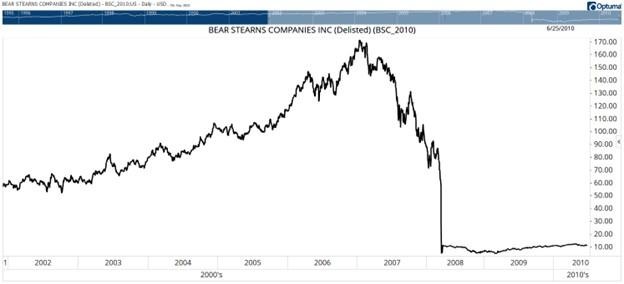
Reviewing the financials may have helped a few investors avoid the stock but many missed the warning signs. I believe long-term analysis can lead to missing the problems in a company like Bear Stearns.
Bear was founded in 1923. The company survived the Great Depression, the high-inflation 1970s, oil booms and busts, tech bubbles and crashes, and countless other crises. Someone knowing that history might believe management was well-suited to navigate the housing crisis. Yet, subprime mortgages were too much to overcome.
In some ways, I think, detailed analysis of financials leads to a false sense of comfort. In many cases, overfamiliarity with the financials can lead to stubborn opinions.
If your study finds the company is growing and well-managed, you may discount problems that develop later. If your study leads you to conclude the company is mismanaged, you might miss signs of a turnaround.
Fortunately, there are other methods of analysis. I do consider financial statements and can develop a valuation model for a company. In fact, I often do. Then I consider whether or not the current stock price provides a margin of safety for investments in that company, as well as the possibility of adequate returns.
What I often find in these models and the possibility of adequate returns isn’t available. You see,
I’m not only analyzing the financials. Thousands of other analysts are doing the same thing. We are all using the same information that the company published. Many of us are using variations of the techniques that Graham explained almost 90 years ago.
When so many people are doing the same thing as that, it’s rare to find bargains in the stock market. Yes, Buffett does. But Buffett built his fortune years ago; he has only rarely beaten the S&P 500 over the last two decades.
I’m not saying Buffett has lost his touch. I am saying there is more competition than ever among value investors and even the greatest investors are finding it difficult to beat the market.
That’s why I take a broader view of Graham’s idea. Thorough analysis is not limited to reading financial statements. It also includes the techniques used to identify opportunities. The trades I take are based on indicators I developed from logical premises and then tested extensively. From there, I focus on finding trades where risk can be clearly defined and managed aggressively. I also concentrate on shorter-term opportunities that allow gains to compound over time—much like Buffett did early in his career, long before he became the world’s most famous investor.
Monthly Income + Share Gains From Silver
This new $42 ETF delivers the best of both worlds: 20% annual distributions, delivered monthly, PLUS 68% share appreciation in just 5 months. Click here to learn more.