
If you spend enough time studying markets, patterns begin to emerge that have very little to do with price and everything to do with behavior. I recently revisited a historical overview of early market participation and the development of Wall Street. While it presents itself as a timeline, what stands out is not the sequence of progress, but the consistency of human responses to uncertainty.
Markets have always been shaped by fear. What has changed is not the presence of that fear, but the ability to measure it and act on it in real time.
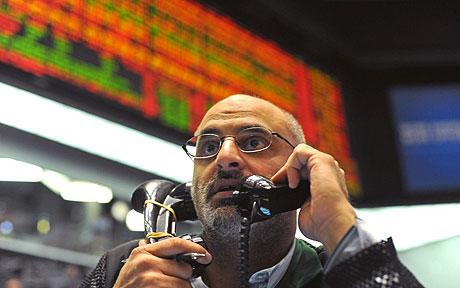
From the Buttonwood Agreement in 1792 to modern electronic trading, market structure has evolved significantly. Yet even in its earliest stages, participation extended beyond those formally recognized within the system, with individuals actively investing, managing risk, and making financial decisions under uncertainty. This is often treated as historical context, but it reveals something more fundamental. Access has never been the limiting factor in market outcomes. It’s always been behavior .
As markets matured, access expanded and information became more widely available. That should have improved decision making. Instead, it introduced more narratives— and more hesitation. The challenge is no longer obtaining information but acting on it before uncertainty resolves.
This becomes most apparent during periods of elevated volatility. When uncertainty expands, participation increases, but conviction weakens. Traders recognize that opportunity exists yet hesitate to engage. The failure is not recognition, but execution. Without a structured process, volatility becomes something to observe rather than something to act upon.
This is where many commonly used indicators break down. Volatility measures such as the VIX are widely accepted as proxies for market fear, but their practical application is limited. As demonstrated in my Dow Award-winning research, volatility spikes are only identifiable in hindsight, and their relationship to market bottoms is inconsistent in both timing and magnitude. The implication is straightforward: if a signal cannot be acted upon in real time, it does not provide an advantage.
The limitation is not volatility itself, but how it is measured. If fear is to be used as part of a decision-making process, it must be evaluated in a way that allows for timely execution. This requires shifting the focus away from identifying extremes and toward identifying change. Opportunity is not created when fear reaches its highest point, but when it begins to contract.
This distinction forms the foundation of the VIX Fix. By applying a simple, repeatable calculation to individual securities rather than relying on a broad market index, the indicator extends the concept of volatility into a practical framework. When combined with a moving average, it provides a clear mechanism for identifying when elevated volatility is returning to more typical levels. This transition from expansion to contraction is where actionable signals emerge.
The effectiveness of this approach lies in its alignment with consistent behavioral patterns. Across multiple market cycles, periods of extreme uncertainty are followed by normalization. This is not a prediction about prices, but an observation about how markets function. Structuring a strategy around this behavior allows for disciplined, repeatable execution.
Backtesting across a broad universe of stocks and multiple timeframes demonstrated that this method produces stronger and more consistent results when applied to weekly data, reinforcing the idea that meaningful signals are often obscured by short-term interference. The strategy is not dependent on specific market conditions, but on the persistence of underlying behavior.
This reframes a question that many traders continue to approach incorrectly.
Rather than attempting to determine whether a market has reached a bottom—a question that cannot be answered with certainty in real time—the more effective approach is to assess whether the conditions that typically precede recovery are already in place. Specifically, whether fear has stopped expanding and begun to recede.
This is a measurable condition. And once it is measured, it can be acted upon.
Broader historical context reinforces this point. Markets have repeatedly presented opportunities during periods of uncertainty, and participants have consistently struggled to act. The constraint has never been the absence of opportunity, but the absence of a framework that allows for decisive execution.
What has changed is not behavior, but the ability to systematically interpret it.
Is this the single most effective way to generate reliable income from options?
According to a former Chicago Exchange floor trader... There's no question about it. Because his new income system has thrown off 36 winners out of his last 41 trades... that's an 87% win rate!
And each winner pays you up to $360, $390, and even $405 in extra income every week...
The best part is that the trades are opened on Wednesdays and closed by Friday's market close. Easy income in less than 48 hours.
Follow this simple 3 step "48 hour income" checklist to get your first trade on Wednesday. Click here for details.