
The world of high-yield option strategy ETFs offers a tremendous range of differentiated funds. One facet I like to compare is finding funds with the same or similar underlying assets, but wildly different distribution yields.
YieldMax has several pairs of ETFs with the same portfolio holdings but different options strategies that focus more on distribution yield or capital appreciation. Here are two to compare:

The YieldMax Semiconductor Portfolio Option Income ETF (CHPY) has a current distribution yield of 45.30%. Here is the fund description from the YieldMax website:
”An actively managed ETF designed to generate current income and capital appreciation through a focused portfolio of approximately 15 to 30 publicly traded semiconductor companies. CHPY seeks to systematically harvest option premiums by selling call spreads on its portfolio holdings, with the goal of distributing income on a weekly basis, while maintaining direct equity exposure to participate in the potential share price appreciation of the underlying companies. Holdings are evaluated based on liquidity, price levels, and implied volatility, with the portfolio reviewed and adjusted regularly as market conditions evolve.”
The YieldMax Target 12™ Semiconductor Option Income ETF (SOXY) has a 12% distribution yield. Here is the description for SOXY from the website:
”An actively managed ETF designed to generate a target annualized distribution of 12% and capital appreciation through a focused portfolio of 15 to 30 publicly traded semiconductor companies. SOXY seeks to generate income by selling call spreads on its portfolio holdings, with the goal of distributing income on a monthly basis, while maintaining direct equity exposure to participate in the potential share price appreciation of the underlying companies. Holdings are evaluated based on liquidity, price levels, and implied volatility, with the portfolio reviewed and adjusted regularly as market conditions evolve.”
You can see that the descriptions are almost identical. CHPY pays weekly dividends while SOXY, with its lower yield, pays monthly.
When the portfolio holdings are compared, they are close enough to be identical to yield the same returns from the stocks held.
When selling call options or option spreads, the further “out of the money” the sold contracts are, the smaller the premium income received, but the greater the upside potential for capital appreciation.
In a rapidly rising market, which has been the case for chip stocks, the ETF with the lower yield should outperform. In a flatter market, going for option premium could be the ticket for higher returns.
CHPY is the newest of the two. It launched on April 2, 2025. We use YCharts to compare total returns since that date.
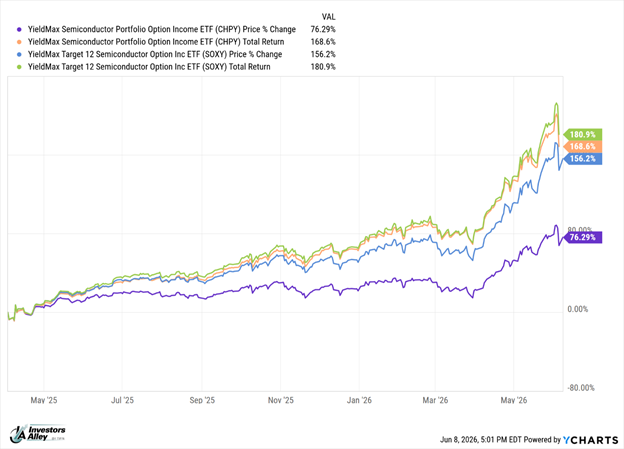
Total returns are surprisingly close. It comes down to whether you want cash dividends or share price appreciation.
You can see that chip stocks went parabolic on April 1 this year. Let’s look at the results for the period before that date.
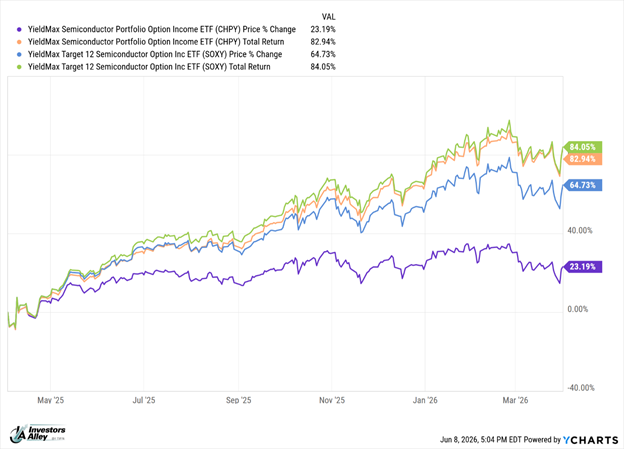
Again, the results are surprisingly close. My takeaway is that in a rising market, either option strategy will work out well. In a flat-to-down market, the CHPY strategy could come up short of its sibling’s results.
"MAG-7 Fund" Turns $500 Into Massive Monthly Income
Wall Street insiders are flooding into a breakthrough fund that transforms zero-dividend tech giants into income machines. One $500 minimum investment opens the floodgates. Click here to start collecting big income from "MAG-7 funds."