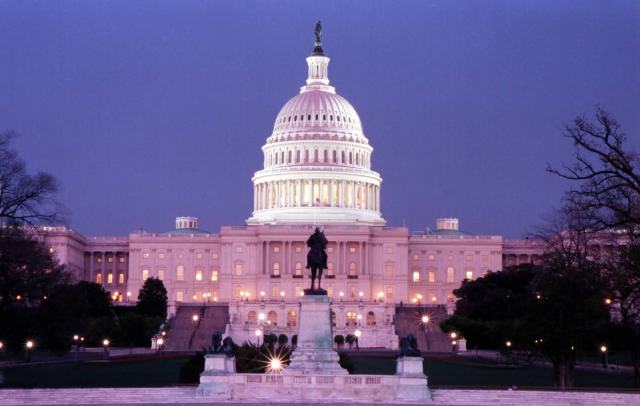
Democrats have won control of both chambers of Congress in the 2026 midterm elections, changing the balance of power in Washington, D.C. But historical market performance offers little evidence that the party’s control of Congress determines where stocks go next.
Since 1946, the S&P 500 and its predecessor index have finished higher in the 12 months following every midterm election. Across those 20 elections, stocks gained an average of approximately 15%, according to research from Guardian Capital. Capital Group independently reports an average gain of 15.4% since 1950.
Several elections illustrate how economic conditions have influenced returns following changes in congressional control.
In 1954, Democrats captured both chambers of Congress during President Dwight Eisenhower’ s first term. The economy was recovering from a recession, and stocks gained approximately 33% over the following year.
Democrats also took control of Congress in 2006 under President George W. Bush. Stocks gained approximately 10% over the next 12 months, but the developing financial crisis eventually reversed those gains. By January 2009, the S&P 500 had fallen approximately 38% from its level at the 2006 election.
In 2018, Democrats regained the House while Republicans retained the Senate. The S&P 500 fell nearly 15% between Election Day and Christmas Eve as the Federal Reserve raised interest rates and trade tensions with China intensified. The market subsequently recovered, finishing approximately 12% higher one year after the election.
Guardian Capital’s research also found that when the president’s party lost control of at least one chamber of Congress, stocks gained an average of 12% over the following year. When the president’s party retained control, the average gain was 18%.
These averages are based on relatively few elections and do not establish a reliable relationship between congressional control and future returns.
The 2026 election leaves President Donald Trump facing a Democratic Congress, potentially limiting major legislative changes. However, corporate earnings, inflation, economic growth, and Federal Reserve policy will continue to influence stock prices regardless of which party controls Washington.
The past 80 years show that stocks have generally performed well following midterm elections, but the path has rarely been predictable. The 2006 election is a particularly useful reminder that a strong first year does not protect the market from deteriorating economic conditions.
That uncertainty is one reason I developed my Income Trader Volatility indicator. Rather than trying to predict how political events will affect stocks, I use it to identify trading opportunities based on actual market behavior.
Everyone’s Talking About IPOs Again. Tim Plaehn Found a Way to Get Paid Monthly
While everyone is talking about SpaceX, Anthropic, and OpenAI, income expert Tim Plaehn is doing something different. He found a little fund that plays the entire IPO wave and pays cash every 30 days: a 20% annualized distribution rate, up to $1,104 in a single month.
Click here to see how IPO Income works.