ETFs that own autocallable notes are a new, hot category of income-focused funds. Of the 20 ETFs of this sort in my database, only three are more than a year old, and 12 launched in 2026.
Autocallable notes are market-linked, structured investment products that produce high-yielding stable income. According to a white paper published by Calamos:
…The callable yield note market represents nearly 70% of all structured note sales in the U.S. within a $200+ billion derivative income landscape. However, accessing these market-linked investments has traditionally required navigating operational and tax complexity, and substantial minimum investments.
The different autocallable ETFs hold notes with varying structures, but nearly all pay yields in the low to mid-teens, with share prices that are more stable than index-tracking funds that use covered call option strategies.

The exception is the Calamos Autocallable Growth ETF (CAGE). As the name suggests, this ETF focuses on growth. CAGE does not pay dividends. Instead, it is managed for share price appreciation.
According to the CAGE webpage, the fund “seeks to generate amplified long-term capital appreciation via synthetic exposure to a laddered portfolio of long-dated autocallable growth options, delivered via exposure to the MerQube US Large-Cap Vol Advantage Autocallable Growth Index.”
With this approach, the income generated from a portfolio of notes accrues to the fund’s share price. Since CAGE tracks an index, it generates no actual income that it would, by law, have to pay out to investors.
The accruing value is reflected in this price chart:
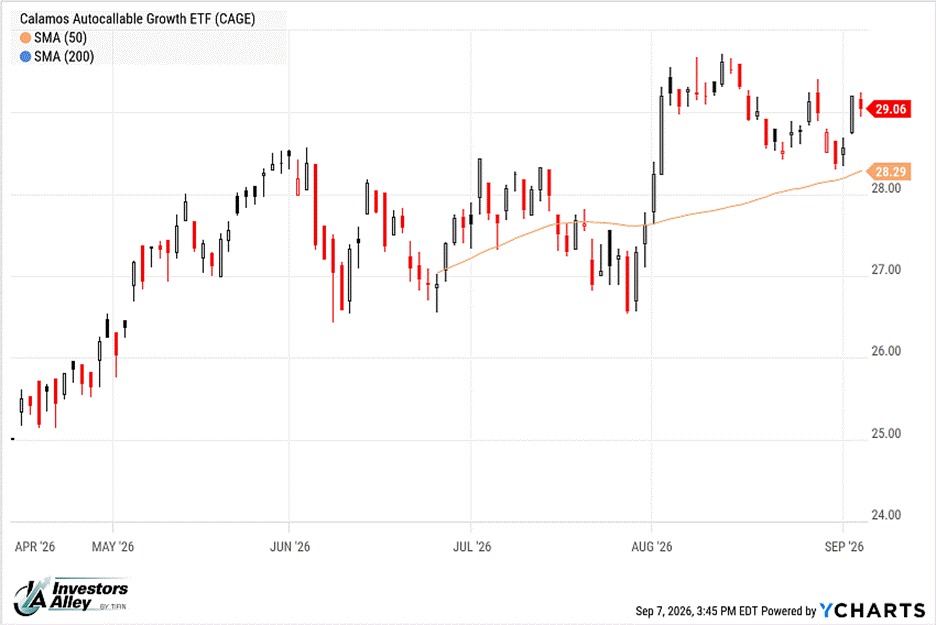
Since its IPO, CAGE is up 16.2%. For comparison, the SPDR S&P 500 ETF Trust (SPY) is up 12.25%, and the Invesco QQQ Trust (QQQ) has gained 9.8%.
If an investor wants to grow a brokerage account using autocallable ETFs, CAGE removes the drag of paying taxes on investment income.
The two Calamos dividend-paying autocallable ETFs yield 14% and 18%, respectively. It seems reasonable to assume CAGE will grow at a similar annual rate.
It will be interesting to watch how this ETF performs over a longer period.
One Rate Play Turned $25,000 Into $99,750. You're Still Early to This Wave.
This move has rolled out in waves all year, and Jay Soloff called them before they hit. The next wave lands September 16. His free presentation shows you where it hits, starting with his #1 stock to own now, ticker and all. Get the free ticker.