
First off, welcome to any and all new Velocity Report subscribers since last month. This is my most growth- and share price appreciation-focused newsletter service. I limit myself to dividend-paying stocks, so there is definitely also a value focus. I also screen for share price momentum.
The rotation by investors out of tech stocks—which had been the only sector many wanted to own for the last three years—into other sectors like energy, materials, industrials, and consumer staples has fueled excellent returns in the Velocity Report portfolio.
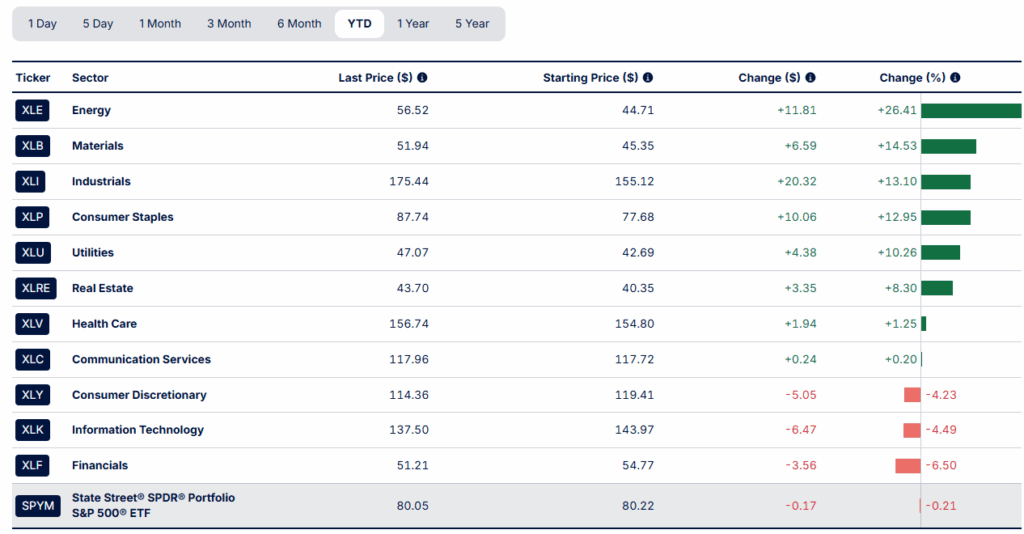
As I write this, the day after the big selloff that followed the attacks in Iran, our portfolio is up 13% year to date. That is awesome, and I hope it holds and continues through the end of Q1.
I generally make portfolio adjustments at the end of each quarter when we rebalance to the recommended position weights. I will, however, recommend trades when the need arises.
A couple of our energy stocks zoomed higher to start the year.
On January 29, right after releasing its earnings, Liberty Energy was up 40% for the year. At that time, I recommended selling one-sixth of your shares. LBRT is our top performer so far this year, up 50%.
On February 9, Kodiak Gas Services (KGS) was up 35%, and I recommended selling 20% of your shares.
On February 19, I sent a note to sell Blue Owl Capital (OWL). This company has been caught up in the private lending fears, and the share price is down 30% year to date. We got out at about $11.40 per share. OWL currently trades for $10.40.
After selling OWL, I suggested letting the trade proceeds go to your cash balance. Currently, the portfolio weighting is 10% in cash. I plan to add another stock for the end-of-month/quarter rebalancing.
AbbVie Inc.
AbbVie, Inc. (ABBV) has been in the Velocity Report portfolio since September 2019. Total return, including share price gains and dividends paid, since then has been 397%. The newsletter was known as Monthly Dividend Multiplier then.
Overview
AbbVie is a leading global biopharmaceutical company headquartered in Chicago, Illinois. The company is focused on discovering, developing, manufacturing, and commercializing innovative medicines and solutions that address complex health issues and improve patients’ lives. Spun off from Abbott Laboratories in 2013, AbbVie has built a robust portfolio centered on high-impact therapeutic areas, including immunology, oncology, neuroscience, eye care, aesthetics, and other areas of significant unmet medical need. With approximately 57,000 employees operating in numerous countries, the company’s medications and technology are used to treat more than 60 million people annually, across more than 75 conditions. AbbVie maintains a strong pipeline of around 90 compounds, devices, or indications in development.
The company’s business is heavily driven by its flagship immunology franchise, which remains its largest revenue contributor. Key products like Skyrizi and Rinvoq have driven strong growth, with combined sales exceeding expectations, and, despite biosimilar competition, AbbVie’s Humira continues to contribute meaningfully to the company’s bottom line. In recent years, AbbVie has successfully transitioned from reliance on older blockbusters to newer therapies, achieving record revenues through diversified portfolios across chronic autoimmune diseases, including rheumatology, gastroenterology, and dermatology.
Beyond immunology, AbbVie has expanded into neuroscience with treatments for conditions like depression, migraines, and Parkinson’s disease (including Botox Therapeutic, Vraylar, Ubrelvy, Qulipta, and newer entries like Vyalev), as well as oncology with therapies targeting blood cancers and solid tumors (such as Imbruvica, Venclexta, and Elahere). The company also invests heavily in research and development, strategic partnerships, and manufacturing expansions (including significant U.S.-based API facilities) to support long-term innovation and growth across its core areas.
Financial Results
For the 2025 fourth quarter, AbbVie reported revenue of $16.6 billion, up 10% year-on-year. Full-year revenue of $61.6 billion, up 9% compared to 2025.
Adjusted, diluted earnings per share of $2.71 for the quarter were 26% higher than a year ago. Full-year adjusted EPS of $10.00 were flat compared to 2024.
The company projects 2026 EPS of $14.37 to $14.57 per share.
In October, ABBV increased its dividend by 5% to an annual rate of $6.92 per share. The annual dividend growth rate over the past five years has been 6.56%. The current yield is 2.96%.
Editor’s Personal Position: Long ABBV
Simon Property Group
Simon Property Group has been in the Velocity Report portfolio since February 2018 when the newsletter was called Monthly Dividend Multiplier. It has posted a 745% total return – share price gains plus dividend payments – since that time.
Business Overview
Simon Property Group, Inc. (SPG) is a leading real estate investment trust (REIT), and the largest owner and operator of shopping malls in the United States. Headquartered in Indianapolis, Indiana, the company specializes in owning, developing, managing, leasing, acquiring, and redeveloping premier retail real estate properties. Simon’s portfolio primarily consists of regional malls, Premium Outlets, Mills centers, community and lifestyle centers, and mixed-use destinations that integrate shopping, dining, entertainment, and other experiences, as well as generating billions in annual tenant sales. As of late 2024 and into 2025, Simon held interests in more than 230 properties across North America, Europe, and Asia
The company’s core operations focus on creating high-productivity retail environments through strategic leasing to a diverse mix of national and international retailers, luxury brands, dining operators, and entertainment concepts. Simon primarily derives its revenue from rental income, with additional streams from property management, redevelopment projects, specialty leasing, advertising, and strategic investments. Simon emphasizes operational excellence, innovation in omnichannel retail, and value-enhancing activities such as expansions, redevelopments, and acquisitions, including significant investments in high-quality assets and international developments, such as new Premium Outlets. This approach has driven strong occupancy rates, record tenant sales per square foot, and consistent growth in funds from operations, supporting substantial shareholder returns as an S&P 100 company.
Investment Considerations
SPG has a current market cap of $77 billion. The current dividend yield is 4.36%.
Fourth-quarter FFO of $3.49 per share was up 4.2% year over year. Full year FFO was $4.8 billion or $12.73 per share. The company earned $12.99 per share in FFO in 2024.
Simon management has guided to a 2026 FFO of $13.00 to $13.25 per share.
In November, SPG increased its dividend by 4.8% to an annual rate of $8.80 per share. During the pandemic, the dividend was slashed by 38%. Since then, the rate has increased every year, and is now above its pre-pandemic level.
Editor’s Personal Position: Long SPG
Walmart Inc.
I added Walmart, Inc. (WMT) to the Velocity Report portfolio in January 2025 when it was Monthly Dividend Multiplier. The stock has returned 42% since that time. WMT has posted a five-year total return of 222%.
Business Overview
Walmart Inc. is a global retail leader operating as a people-led, tech-powered omnichannel retailer focused on helping customers save money and live better. The company manages a vast network of more than 10,800 stores across 19 countries, serving approximately 280 million customers every week through physical locations and digital platforms. Its core operations revolve around providing everyday low prices on a broad assortment of groceries, general merchandise, health and wellness products, and services, delivered through formats like Supercenters, discount stores, Neighborhood Markets, and Sam’s Club membership warehouses. This extensive physical footprint underpins Walmart’s business, enabling convenient in-person shopping while supporting its low-cost model through high-volume sales and efficient scale.
A key pillar of Walmart’s operations is its unrivaled global supply chain, which handles more than 100 billion items annually. The company prioritizes information and data sharing over excess inventory, using advanced technologies like artificial intelligence, automation, and real-time systems to predict demand, optimize routes, reduce waste, and enable “self-healing” inventory that automatically redirects stock where needed. With hundreds of distribution centers and fulfillment facilities, Walmart achieves rapid replenishment, supports high-quality fresh food, and maintains low operational costs. This efficiency underpins the company’s signature “Everyday Low Prices” promise and strengthens its bargaining power with suppliers through direct collaboration and transparent data systems such as Retail Link.
Overall, Walmart’s operations generate massive scale through efficient management of inventory, logistics, and customer experiences across its segments: Walmart U.S., Walmart International, and Sam’s Club. By combining a vast store network, cutting-edge supply chain technology, and omnichannel innovation, the company sustains its dominance in retail, supports millions of jobs globally, and continues expanding its focus on value, quality, and accessibility in a dynamic market.
Financial Results
For the 2025 fourth quarter, Walmart reported revenue of $190.7 billion, up 5.6% year over year. EPS came in at $0.74 per share. Of note, the global e-commerce business grew by 24%, led by store pickup & delivery.
Full revenue was $713.2 billion, up 5.1% compared to 2024. The earnings release highlighted that operating earnings grew more quickly than revenue.
In February, the company increased its dividend by 5.3%, to an annual rate of $0.99 per share. Walmart has grown its dividend for 52 consecutive years. The five-year annual dividend growth averaged 5.5%.
Interesting fact: since 1975, Walmart has announced 10 stock splits. The most recent was a 3-for-1 split in February 2024. If an investor owned 100 shares in 1975, before the first split, she would own 153,600 shares today. I wish my time machine weren’t broken!
Editor’s Personal Position: Long WMT
Portfolio Update
Dividend Changes
On February 24, Diamondback Energy (FANG) declared a $1.05/share quarterly dividend, a 5% increase from prior dividend of $1.00. This dividend will be paid on March 12; ex-dividend was March 5.
On February 20, Federal Agricultural Mortgage (AGM) declared a $1.60/share quarterly dividend, a 6.7% increase from prior dividend of $1.50. This dividend will be paid March 31; ex-dividend is March 16.
On February 19, Walmart (WMT) declared a $0.99/share annual dividend, a 5.3% increase from prior dividend of $0.94. This dividend will be paid in four quarterly installments:
- Q1 payment is April 6; ex-dividend is March 20
- Q2 payment is May 26; ex-dividend is May 8
- Q3 payment is September 8; ex-dividend is August 21
- Q4 payment is January 4; ex-dividend is December 11
On February 12, CME Group Inc. (CME) declared a $1.30/share quarterly dividend, a 4% increase from the prior dividend of $1.25. This dividend is payable March 26; ex-dividend is March 10.
On February 4, American Financial Group (AFG) declared a $1.50/share special dividend. This special dividend was paid February 25; ex-dividend was February 16.
Here is a rundown on the dividend status for each of the Velocity Report portfolio stocks, as of this writing:
Abbvie Inc. (ABBV) declared a $1.73 dividend on February 19. Payment is May 15; ex-dividend is April 15. The current yield is 2.98%.
American Financial Group (AFG) declared a $0.88 dividend on January 2. Payment was January 27. The current yield is 5.28%.
Federal Agricultural Mortgage Corp. (AGM) declared a $1.60 dividend on February 20. Payment is March 31; ex-dividend is March 16. The current yield is 4.06%.
Antero Midstream (AM) declared a $0.225 dividend on January 14. Payment was February 11. The current yield is 4.00%.
CME Group Inc. (CME) declared a $1.30 dividend on February 12. Payment is March 26; ex-dividend is March 10. The current yield is 3.55%.
EQT Corporation (EQT) declared a $0.165 dividend on February 5. Payment was March 2; ex-dividend was February 17. The current yield is 1.07%.
Diamond Back Energy, Inc (FANG) declared a $1.05 dividend on February 24. Payment is March 12; ex-dividend was March 5. The current yield is 2.41%.
Fidelity National Financial (FNF) declared a $0.52 dividend on February 20. Payment is March 31; ex-dividend is March 17. The current yield is 3.932%.
Kodiak Gas Services (KGS) announced a $0.49 dividend on January 29. Payment was February 20; ex-dividend was February 13. The current yield is 3.59%.
Liberty Energy (LBRT) announced a $0.09 dividend on January 20. Payment is March 18; ex-dividend was March 4. The current yield is 1.28%.
Marathon Petroleum Corp (MPC) declared a $1.00 per share dividend on January 30. Payment is March 10; ex-dividend was February 18. The current yield is 2.02%.
Blue Owl Capital, Inc. (OWL) announced a $0.225 dividend on February 5. Payment was March 2; ex-dividend was February 20. The current yield is 8.53%.
Bank OZK (OZK) announced a $0.46 dividend on January 2. Payment was January 20. The current yield is 3.95%.
Royal Gold, Inc (RGLD) declared a $0.475 per share dividend on February 26. Payment is April 16; ex-dividend is April 2. The current yield is 0.63%.
InfraCap Small Cap Income ETF (SCAP) declared a $0.24 monthly dividend on January 9. Payment was February 27 to shareholders of record as of February 26. The current yield is 6.77%.
Simon Property Group (SPG) announced a $2.20 dividend on February 2. Payment is March 31; ex-dividend is March 10. The current yield is 4.32%.
VICI Properties Inc. (VICI) announced a $0.45 dividend on December 4. Payment was January 8. The current yield is 5.96%.
Walmart Inc, (WMT) announced a $0.235 dividend on February 19. Payment is April 6; ex-dividend is March 20. The current yield is 0.77%.