The Setup Has Not Changed: Oil Is Still Expected to Drop This Year, And The Right Energy Stocks Can Still Win
The last couple of days delivered the exact kind of headline-driven shock that makes most investors forget the larger trend. A military strike involving Iran injected a risk premium into crude, with global benchmarks jumping sharply on fears of disruption around the Strait of Hormuz.
That spike matters for traders. But for investors positioning for the rest of 2026, the more important question is simple:
Does the spike change the base case that oil prices trend lower over the year?
Right now, the most useful way to answer that is to separate event risk (what happened in the last 48 hours) from structure (supply, inventories, and policy decisions that persist for quarters). This is where our thesis – that oil prices are in a longer term downtrend – continues and why our Energy Surge Trifecta stocks, those being Diamondback Energy, Kodiak Gas Services, and Marathon Petroleum Corporation, remain optimal long term investments.
1) The structural forecast still points down
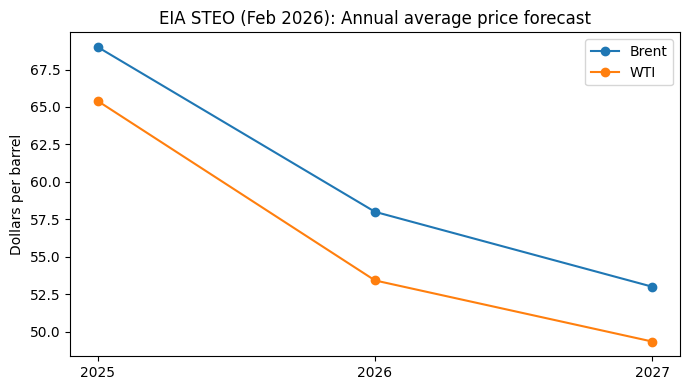
The U.S. Energy Information Administration’s Short-Term Energy Outlook (STEO) continues to frame a “downward drift” for crude prices over the next several quarters. In its February 2026 STEO, EIA’s forecast implies:
- WTI averaging about $53.42 in 2026, and about $49.34 in 2027
- Brent averaging about $58 in 2026 and about $53 in 2027
EIA’s “why” is just as important as the numbers: their balances incorporate inventory builds, which historically put pressure on prices. (Even earlier STEO commentary has repeatedly emphasized that inventory growth tends to weigh on crude.)
The key takeaway for readers: the forecast path is lower even without assuming geopolitical calm. Geopolitical shocks create spikes, but inventories and supply discipline (or lack of it) determine the grind.
2) The March 1 OPEC+ signal leaned toward supply, not shortage
During the March 1, 2026 OPEC+ meeting, the group decided to increase production by 206,000 bpd in April. That detail matters because it reinforces the idea that even as tensions flare, the group is still managing a multi-quarter plan to bring barrels back rather than lock down supply indefinitely.
Investors often assume “geopolitical risk = sustained higher oil.” But OPEC+ policy is part of the counterweight. When the group is adding barrels into the forward months, it dampens the durability of a headline spike.
The “Great Separation” is the real opportunity
While the talking heads in financial media drone on about rising oil prices as if what is happening today is permanent, they miss the more historically accurate concept: big money in energy is often made during oil drawdowns, because the sector stops trading as “one thing” and starts trading as a sorting machine.
In my presentation I termed this “separation.”
When crude reprices lower:
- High-cost, over-levered producers get punished.
- Low-cost consolidators can gain share and buy assets cheaply.
- Fee-based infrastructure keeps collecting (and often gets busier).
- Refiners can see margins expand if product demand holds.
That’s why this update keeps the same core stance: oil can drift lower through 2026, and FANG, KGS, and MPC can still do well, for different reasons.
Why these three can work in a “lower oil” regime
Diamondback Energy (FANG): the low-cost consolidator in the producer stream
If crude slides toward the low-to-mid $50s, the question is not “who produces oil,” it is who produces profitably and who is forced to shrink.
Diamondback has been explicit about a shareholder-return model funded by free cash flow. In its Q3 2025 release, the company highlighted:
- Oil production of 503.8 MBO/d (942.9 MBOE/d total)
- Net cash from operating activities of $2.4B
- Free cash flow / adjusted free cash flow of about $1.8B
- Share repurchases of ~4.29M shares for ~$603M at a $140.70 weighted average price
That matters in a down-oil tape because the long-run winners are the companies that can keep funding dividends, buybacks, and opportunistic consolidation, without relying on $80 oil.
Kodiak Gas Services (KGS): “toll road” cash flows plus an AI-power adjacency
KGS fits our “toll road” logic: contract compression is more driven by activity and volumes than day-to-day oil prices.
A newer look is Kodiak’s move into distributed power, which links hydrocarbons to data-center power demand. Kodiak announced an agreement to acquire Distributed Power Solutions in a transaction valued around $675M.
Why this matters in a “lower oil” thesis:
- If crude falls because supply is ample, that generally implies U.S. activity does not collapse evenly. The best basins keep drilling, and gas infrastructure remains essential.
- The data-center power buildout can support a separate demand driver that is not purely oil-price dependent.
Marathon Petroleum (MPC): the refiner stream that can benefit from cheaper crude
Refiners are the cleanest expression of the “oil down can be good” argument when product demand holds.
Marathon’s Q4/full-year 2025 results emphasized:
- Q4 adjusted EPS of $4.07
- Full-year refining utilization of 94%
- Margin capture of 105%
- Cash from operations of $8.3B
- Capital returns of $4.5B in 2025
MPC also highlighted that MPLX’s growing distribution is expected to be large enough to more than fund MPC’s 2026 dividend and standalone capital, which structurally supports ongoing buybacks.
So if oil drifts lower over the year, the “refiner math” can still work with cheaper crude inputs, resilient demand for gasoline/diesel/jet fuel products, and a capital-return engine supported by midstream distributions.
How to think about the Iran spike without losing sight of the longer term trend
- Yes, the Iran strike spiked crude. It is real risk premium tied to potential disruption fears (especially around Hormuz).
- No, one spike does not negate a year-long inventory and supply trajectory. EIA’s forward view still maps to lower average prices in 2026 versus 2025.
- OPEC+ announcing on March 1st that they adding 206,000 bpd in April is a reminder that supply policy is still pushing barrels back into the system, not removing them.
- That is exactly why “separation” matters. You do not need oil prices to climb to make money. You need the right businesses for making money when oil is down.
Price forecasts and charts (EIA STEO-based)
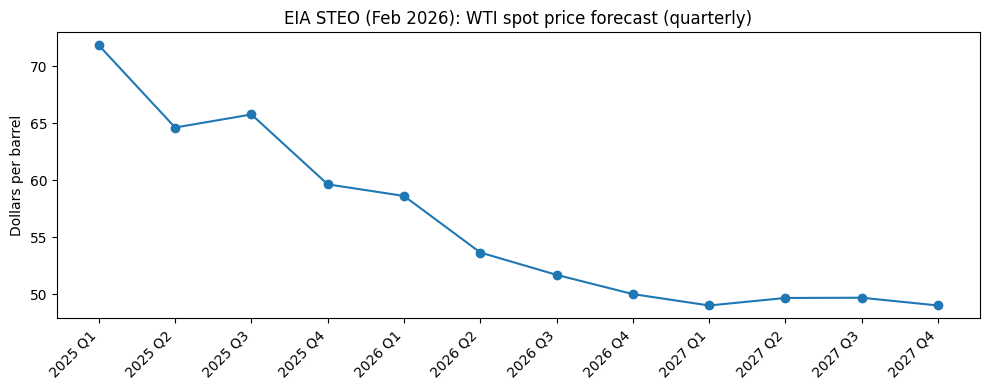
I want to leave you with two charts that I think sum up the situation. Remember, during yesterday’s OPEC+ meeting they decided to increase production, something that absent military action against OPEC’s #4 producer would drive prices down… and will do so over the longer term. The charts below reflect EIA STEO (Feb 2026) forecasts. These were before the Iran strikes but as I’ve said, this is temporary and not reflective of the longer term trend.
- WTI quarterly forecast trend: down through 2026, then stabilizing around the high-$40s in 2027.
- Annual average forecast: Brent and WTI both lower in 2026 and lower again in 2027 versus 2025.
Be sure to join me on Wednesday at 4:30 p.m. eastern for our live monthly webinar. We’ll have lots to talk about including our oil stocks and recent events. The Zoom link is https://us02web.zoom.us/j/89682189402
Some of the research done to complete this report was AI-assisted.