
Looking for a Bottom in the MLP/Energy Sectors
As I write this, the benchmark West Texas Intermediate crude is trading under $40 per barrel for the first time since early 2009. The steep drop in crude – down to below $40 over the last two months – has triggered a true bear market in the energy and MLP sectors of the stock market. Current market conditions have left me with a lot to talk about, and the conclusions I come to at the end of this section I hope will be useful and interesting to you.
Point Number 1
Energy businesses require a long-term outlook, plan, and investment. Changes in supply and demand happen slowly, taking many months, if not years. Financial markets are short-sighted and react very quickly to tiny bits of information that will probably have very little long-term effects. Traders can and do push commodity prices, such as crude oil, to extremes that are not justified by the underlying fundamentals. Can you remember the reasons why WTI went from $50 to $140 to $35 between January 2007 and January 2009? The financial world went through a crisis, and economies a recession, but crude oil demand only dropped slightly for a short period of time as the globe worked its way through the financial crisis driven recession.
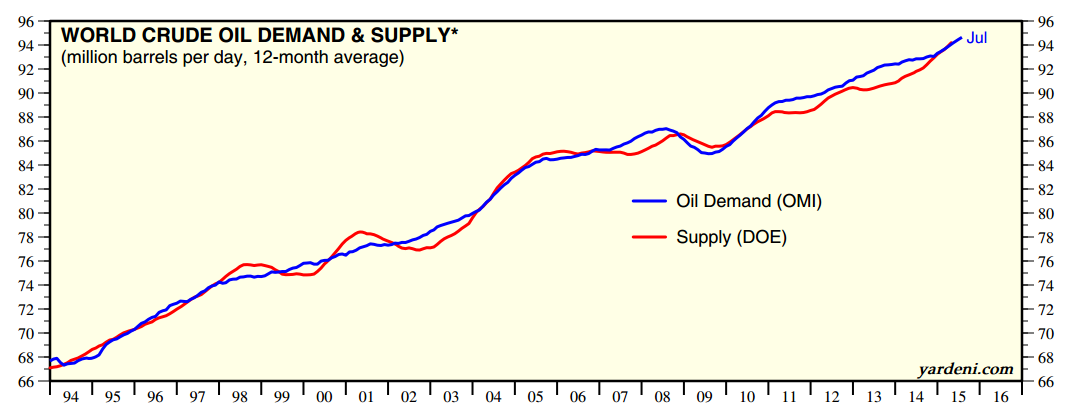
This time around the drop in energy prices is not from a global recession. But, rather due to production growth over the last decade in the U.S. and Canada that has caused a slight global over-supply. During the 2010 to late 2014 period of $80 to $110 oil, the rest of the world was not able to increase its production levels. This has led to a paradigm shift in the global energy market that is not yet widely recognized. Here are some of the factors I see in this new market:
- The U.S. land-based E&P companies have become the low-cost producers of the world. These companies will continue to improve their drilling efficiencies and lower costs so that they stay profitable even with crude at $40 or lower. This means that production declines will not come from the U.S. – a good thing for midstream MLPs.
- The rest of the world is pumping every barrel they can to generate cash to support government programs and other non-profit related costs. These regions need $90+ oil just to cover their obligations and even higher prices to justify capital spending to replace the inevitable production decline from existing oil fields. Currently, places like Mexico, Venezuela, Nigeria, Russia, Norway, and even Saudi Arabia are spending all of their oil revenues on other obligations and not investing any money to offset decline rates. I found this nugget of information a month or so ago:
“Oil companies need to replace between 5% and 8% of crude output each year just to offset shrinking production from old wells, analysts estimate. But only six major oil projects worldwide received a go-ahead last year, compared with an average of more than 20 a year from 2002 to 2013, according to Deutsche Bank.”
- Competition in the global oil business has now become U.S. based profit-driven companies against the rest of the world’s nationalized high cost, high spending crude oil businesses. I think I would rather bet on the U.S. competitiveness vs. nationalistic systems.
Point Number 2
With their second quarter results, 86% of all MLPs maintained or increased their distributions and 73% announced distribution increases. Average year over year distribution growth was 2.4%, with infrastructure focused MLPs growing payouts by double digits on average year over year.
The drop in MLP values across the board has pushed up yields with an average of 7.2%. The Alerian MLP Equal Weight Index is yielding over 8%. With these yields, MLPs are now yielding 500 to 600 basis points (5% to 6%) more than the 10-year U.S. Treasury yield. The 500 bp spread has historical significance. In the 20 year history of MLPs as a sector, the yield spread has been greater than 500 bp only 5% of the time. The typical range is 200 to 400 bp over the 10-year yield. Whenever that spread has exceeded 500 bp, the MLP sector has been higher one year later 100% of the time. Total returns have ranged from 20% to 40% for the next 12 months.
It is possible to probable that we will see more volatility (market code for falling prices) as the commodity sector tries to find a bottom for crude oil. I view the current market as a good time to pick up units of higher quality MLPs at yields that are well above the historical averages.
Next Up: A quick look at the MLP Sectors
MLP Overview and Outlook by Sectors
With energy prices dropping, I want to provide a quick overview of the different energy subsectors in the MLP space.
Upstream MLPs are the oil and gas producers, they own and operate wells in the various energy producing regions. In this group, unit prices have collapsed on falling energy prices and deep distribution cuts. Linn Energy LLC (Nasdaq:LINE) put an extra shock into the market by suspending distribution payments starting in Q4 2015. At this point these MLPs have become speculative investments on whether crude increases or not. I actually find Linn to now be intriguing, because the company is hoarding cash, providing an opportunity for acquisitions or just to extend the company’s viability as an ongoing operation if crude stays down through 2016. I am not making any upstream recommendations here, but I understand if you might want to pick up some units of Linn, Legacy Reserves (Nasdaq:LGCY) or Vanguard Natural Resources (Nasdaq:VNR) as alternatives to going long crude futures or crude price tracking ETFs. Legacy and Vanguard are the only two upstream MLPs to put together meaningful acquisitions in the current low asset pricing environment.
The midstream MLP sector is the largest, and to a great extent, most diversified. Many of these companies provide essential infrastructure services to the energy sector. The Alerian Infrastructure Index –AMZI– which tracks the 25 largest midstream MLPs is down 23% since the first of May, not including distributions. Yet, 100% of midstream MLPs maintained or increased distribution rates for the second quarter, with the majority announcing increases. Those partnerships with significant gathering and processing revenues face the biggest growth challenges. These companies depend on new well completions to generate fee or commodity based revenue growth. Low NGL pricing has also hurt the partnerships with significant processing revenues. Probably the extreme example, is Targa Resources Partners LP (NYSE:NGLS), which is down 40% in the last three months and yielding over 12%. This has been a very steady high single digit distribution growth MLP since 2010. With distribution growth slowing in this bunch, investors must be satisfied with high current yields and patiently wait for an energy recovery. Stable, larger MLPs are my recommendations here.
High-growth midstream MLPs offer a different picture. Most of these units have good visibility for future distribution growth; the market, however, doesn’t seem to care. It is a good time to add or start positions in the companies with lots of sponsor assets that can be dropped to the MLPs to sustain growth rates. Portfolio recommendation Valero Energy Partners LP (NYSE:VLP) is one of these along with Phillips 66 Partners LP (NYSE:PSXP), Shell Midstream Partners LP (NYSE:SHLX), and Dominion Midstream Partners LP (NYSE:DM). Following the recent drop in MLP unit values, I am adding PSXP to the Tax-Smart Income Hunter Total Return Portfolio.
The downstream energy sector is where the money is now being made. I specifically refer to crude oil refining. Refiner profits are driven by market commodity prices, both the crude oil inputs and refined fuels output. A refiner will report its refining margin each quarter, showing the gross profit per barrel. These margins can be estimated by tracking a commodity price crack spread, using benchmark crude oil and fuel prices. I track a NYMEX crack spread using the spot WTI crude price and New York Harbor spot prices for conventional gasoline and ultra-low sulphur diesel fuel. These prices are provided by the Energy Information Agency and updated weekly. Scotia Howard Weil also provides a weekly report with some regional crack spread information, which I use to predict refining margins.
In 2015, crack spreads have been steadily widening. Last year, 2014, saw very steady spreads, with my NYMEX based spread staying in a steady $18.50 -$18.80 per barrel range for the entire year. This year, the spread was $21.04/barrel in Q1, $22.22 in Q2, and is at $24.02/barrel to-date for Q3. Refining expenses per barrel are pretty much fixed, so greater refining margins fall directly to the bottom line. The three refining MLPs all have variable distribution policies, paying out almost all of their free cash flow each quarter. Here are the three MLPs, their distributions for Q1 and Q2, and current yields based on Q2 payouts:
- Alon USA Partners LP (NYSE:ALDW): $0.71, $1.04, 16.8%.
- CVR Refining LP (NYSE:CVRR): $0.76, $0.98, 15%.
- Northern Tier Energy LP (NYSE:NTI): $1.08, $1.19, 17.2%.
Third quarter distributions should be higher again. However, after Q3, the summer driving season is over, so spreads may narrow. Right now it is possible that NTI could pay a quarterly distribution in excess of 5%, based on the current unit price and I am adding the MLP to Income Portfolio. I will cover the partnership with next week’s individual MLP report.
Tax-Smart Income Hunter Portfolio Update
To start, I have added two MLPs to the recommendations portfolio.
Northern Tier Energy LP (NYSE:NTI) has been added to the Income Portfolio.
Phillips 66 Partners (NYSE:PSXP) is now a recommendation in the Total Return Portfolio.
Second quarter earnings and distribution announcements have come out since the last Tax-Smart Income Hunter newsletter. Here are some highlights:
Oneok Partners (NYSE:OKS) kept its distribution level at $0.79 per unit. On August 12, the company announced an equity capital raise which involved selling 21.5 million LP units to parent company ONEOK (NYSE:OKE) and 3.3 million units to fund manager Kayne Anderson. The $700 million capital raise will help pay for Oneok’s capital spending projects for the rest of 2015 and into 2016.
NGL Energy Partners (NYSE:NGL) increased their distribution by 1.2% over Q1 and their new rate is 7.4% higher than a year ago. NGL has a portfolio of in-development projects that will provide continued EBITDA and DCF growth.
Plains All American Pipeline (NYSE:PAA) increased its distribution 1.5% quarter over quarter, and 7.75% above a year ago. Management indicated that distribution growth could be flatter through 2016 in the current energy price environment.
The MLP Income Portfolio holdings, less NTI, have a current average yield of 10%. Not a bad wage while waiting for the next leg up in the MLP sector.
CONE Midstream Partners (NYSE:CNNX) announced its third distribution since the September 2014 IPO and first quarterly increase. The Q2 distribution rate is 3.5% higher than the rate paid for Q1. Results for the quarter were above the IPO projections for this point in the company’s history. The market doesn’t seem to get CNNX, and the unit price is down one-third from when I added the MLP to the portfolio on July 1. I think it will turn eventually, and the current yield of 7.7% is attractive.
Valero Energy Partners (NYSE:VLP) Q2 distribution was up 5.4% over Q1 and up 31.5% year over year. Valero has $1 billion of midstream EBITDA assets that can drop to VLP. Great growth story.
EQT Midstream Partners (NYSE:EQM) has been increasing its quarterly distribution by 3 cents every quarter since the beginning of 2013. For Q2, that represents 4.9% quarter over quarter and 23% year over year growth.
Tallgrass Energy GP (NYSE:TEGP) is the general partner of Tallgrass Energy Partners (NYSE:TEP) the midstream MLP with the fastest distribution growth over the last couple of years. TEGP came to market with a May 7 IPO and paid a partial distribution for Q2. We will get our first look at the distribution growth rate in November.
The Total Return Portfolio has a current yield of 4% and a forecast of 25% average annual distribution growth.
Kinder Morgan Inc. (NYSE:KMI) increased its dividend by 2.1% over the second quarter. Management repeated dividend growth guidance of 10% per year through 2020. Buying KMI at $30 per share and with a 6.4% yield feels like stealing.
I had some communications with the management team for the InfraCap MLP ETF (NYSE:AMZA). Remember this is the only actively managed MLP-focused ETF. The fund’s covered call strategy is performing well and management has been buying put options on the crude oil ETFs to boost cash flow as the price of oil falls. The AMZA share price has been tracking right along with the AMZI index but pays over twice the yield.
The two recommended IRA holdings have a current average yield of 9.5% and both are increasing dividends every quarter.
Positions: Long, VLP, AMZA, KMI, EQM