
Tax-Smart Income Hunter: July 22, 2015 Issue
This is the first monthly issue of Tax-Smart Income Hunter, Tax Advantaged Investing With MLPs and Energy Infrastructure Stocks. It is an interesting time to launch an MLP focused newsletter. Just to be clear, Tax-Smart Income Hunter is published weekly, however once a month you’ll receive a longer than usual issue. In the “monthly issue” we’ll get into many more details. So let’s get started.
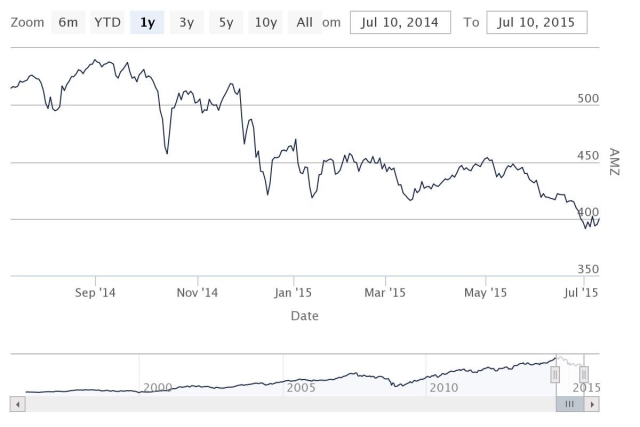
The big declines in energy prices, especially crude oil, have led to a general sell off in the MLP sector. That selling based on energy values has led to further price declines as the fickle money that jumped into MLPs when they were hot continues to leave the sector. It can be hard to see where the buying interest that would fuel a rally will come from. This chart of the Alerian MLP index illustrates the recent ugliness in the sector.
The positive news is that the energy sector sell off has pulled down the values of the very good MLP companies along with those that will be hurt by lower energy prices. Many midstream companies have businesses that will be fine or even thrive in the current energy price environment. Here are some factors that could help the better MLPs hit or exceed their growth goals:
- Acquisitions or mergers that allow financially strong companies to buy assets on the cheap.
- Demand pull as more electricity is generated from natural gas and manufacturing builds facilities to take advantage of low natural gas liquids (NGLs) prices.
- The MLP structure provides a great way for large energy companies to monetize midstream and logistics assets.
- Even with a slowdown in crude oil and natural gas production, tens of billions of dollars will be spent developing energy infrastructure assets over the next two decades.
- The new breed of high growth MLPs backed by large sponsor asset inventories.
- The yield combined with distribution growth potential from the better MLPs remains one of the best investment theses out there.
The big change since a year ago is that you cannot throw money at any MLP and expect a 15% or better total annual return. The best returns will be found by company analysis and comparison. That’s the point and goal of the Tax-Smart Income Hunter.
Last week, I made several presentations at the MoneyShow in San Francisco. My, “Oil Crash Investing: Separating the Safe from Dangerous MLPs” drew a big crowd and lots of questions. Income investors are still interested in MLPs, but are starting to understand that smart choices are needed to earn top returns. There still may be some additional pullbacks for the MLP sector, and investors need to make MLP choices with a holding period of several years in mind.
Here at the Tax-Smart Income Hunter I will provide analysis on most of the MLPs trading in the markets, a portfolio recommendations list and plenty of material that explains how MLPs operate. This is a market sector that, more than most, will reward the well informed.
How MLP’s Grow Their Businesses
Master limited partnerships use a business growth model that operates differently than how most publicly traded, growth focused corporations operate. A corporation typically relies on the reinvestment of profits and possibly new debt to fund growth projects. As a result, a publicly traded corporation must do the following with its net profits:
- Pay Corporate Income Taxes – the government takes between 35% and 40% off the top.
- Fund growth initiatives and projects.
- Pay dividends to shareholders.
As a result, a growth focused corporation will have little cash flow available with which to pay dividends. Shares of publicly traded corporations are typically evaluated on earnings per share (EPS) growth. The predictability and rate of EPS growth drives the share price. A corporation that wants to be viewed as a dividend investment will still rarely pay out more than 50% of EPS as dividends. With Uncle Sam taking 35%, a 50% payout leaves little cash to be reinvested in the company. These facts are why income investors get better cash flow “deals” from pass-through entities like REITs and MLPs.
The investment story of publicly traded partnership units varies significantly from an investment in shares of a corporation. With a purchase of MLP units, the return will be the combination of cash distributions paid by the partnership and the growth rate of the distribution payments. The total return expectations from an MLP should be based on the combination of yield and distribution growth rate. Most midstream MLPs set annual distribution growth targets and many increase their per unit payouts every quarter. So how does an MLP generate cash flow growth year after year?
An MLP grows by adding fee generating assets, such as pipelines, storage facilities or loading/unloading terminals. MLPs provide the infrastructure of the energy sector and you will find a wide range of asset types owned by the different partnerships. A new asset can be built from scratch or acquired from another party. How a company adds new assets to generate a growing revenue and cash flow stream is one of the primary factors when analyzing an MLP for investment potential. A midstream asset that a company builds itself typically generates a mid-teens annual internal rate of return (IRR) rate of return on invested capital. It can take several years or longer to get approval to construct a new project, get customers lined up and confirmed (this is a crucial step) and then actually build the project. Tens to hundreds of millions of dollars can be tied up during the process and years before that capital starts to generate a return. With the other acquisition strategy, the cash flow return on an acquired asset is typically lower. In the current market you typically see EBITDA cash flows of 7% to 10% of the capital cost. When an MLP buys an asset, the cash flow return starts almost immediately, justifying the lower expected IRR.
In most cases, an MLP will fund an acquisition with a combination of equity and debt capital. This means that to grow, the MLP will issue more common units and increase its debt load. This is an important concept to understand, a growing MLP will have a steadily increasing number of common equity units and a steadily increasing level of debt. Generally, the business model does not follow the corporate practices of buying back shares to increase EPS. Also, an MLP will not attempt to pay down debt. Debt will be refinanced as it comes due. Midstream energy assets have very long operational lives, 30 years or longer. The fees generated by these assets are stable to growing. It does not hurt an MLP to have a growing debt load as long as the EBIDTA grows at a faster rate.
To analyze an MLP’s project funding, we look at the company’s blended cost of capital. This cost is a combination of equity unit yield, added cost of general partner incentive distribution rights, and the company’s interest costs on new debt. For example, the current yield of Plains All American Pipelines LP (NYSE:PAA) common units is 6.3%. Incentive distribution rights (IDRs) paid to the general partner add about 2% increasing PAA’s cost of equity financing to 8.3%. Plains has an investment grade credit rating, and it pays 4.7% to borrow using long term debt. If a new project is funded 50/50 with equity and debt capital the partnerships cost of capital is 6.5%. Plains is an MLP that primarily develops its own projects, so the new business focus is on opportunities to generate IRR’s of around 15%. The MLP builds projects that return 15% per year at an annual cost of 6.5% per year, producing a growing free cash flow stream that allows Plains All American to grow its distributions to unit holders.
This growth model allows us to look at the history of an MLP and see how well it has generate a growing cash flow stream and paid an increasing distribution to investors. We can then look at the future project backlog to estimate growth prospect. Finally, the blended cost of funds gives us an indication of how risky or conservative the MLP needs to or can be to generate growing and unit accretive cash flow.
Portfolio Recommendations Review
The Tax-Smart Income Hunter portfolio recommendations are divided into three different categories: MLP Income, Total Return, and IRA Appropriate. You can find current values and yields on the portfolios page with your login on the Investors Alley website.
MLP Income Portfolio holdings carry high current yields with moderate distribution growth expectations. In the current energy price environment, the holdings are focused on large-cap, high quality MLPs. With these holdings, the average current yield of 8.5% is what you collect while waiting for energy prices and the stock market sector to recover.
- Oneok Partners (NYSE:OKS) did not increase its distributions for Q1, thus the near 10% yield. This large cap investment grade MLP can generate up to 10% annual distribution growth with more aggressive drilling in the plays it serves and higher NGL prices.
- Plains All American Pipelines LP (NYSE:PAA) announced a 1.5% distribution increase for Q2. One of the most conservatively managed of the large-cap MLPs, but still delivers attractive yield plus distribution growth of 6% to 7% in the current market.
- NGL Energy Partners (NYSE:NGL) is a smaller, $2.8 billion market cap MLP that has generated superior growth through acquisitions. That growth has been undervalued by the market as indicated by the 9% yield. Expect significant unit price volatility with this one.
The Total Return portfolio contains my selections out of the high distribution growth end of the MLP yield vs growth spectrum. These are MLPs with projected distribution growth in the high teens and up. The investment thesis is that distribution growth will fuel significant, corresponding unit value increases. In the short term, the market does not always follow the distribution growth prospects playbook, providing a chance to buy growth on the cheap. These MLPs tend to be young with deep-pocket sponsors that have vested interest to make sure growth projections come to pass.
- CONE Midstream Partners (NYSE:CNNX) just announced its first meaningful distribution increase after its late September 2014 IPO. The Q2 distribution will be 3.5% higher than the Q1 payout.
- Valero Energy Partners (NYSE:VLP) has increased its distribution by 30% in the last year, through the Q1 payout. Unit price is down 10% over the same period. Expect another 6% to 7% payout increase later this month.
- EQT Midstream Partners (NYSE:EQM) has been a steady 24% annual distribution growth machine since its mid-2012 IPO. Expect the trend to continue as units are a value with a 3.25% yield and 25% below last year’s peak.
- Tallgrass Energy GP LP (NYSE:TEGP) is the general partner of hyper-growth MLP, Tallgrass Energy Partners LP (NYSE:TEP). The Tallgrass GP just launched with a May 2015 IPO. TEP has been increasing distributions at an 8% to 10% per quarter rate. General Partner incentive distribution rights math should allow TEGP to double TEP’s growth rate. I am curious to see how the market prices 20% per quarter distribution growth. TEGP is a Form 1099 reporting company.
The IRA Appropriate portfolio investments provide MLP related returns from 1099 reporting entities. I recommend against owning K-1 reporting investments in IRA-type accounts.
- InfraCap MLP ETF (NYSE:AMZA) is the first actively managed ETF in the MLP sector. The fund owns the same MLPs as the Alerian Infrastructure Index, but has the flexibility to weight holdings differently, write covered-call options and own the GP companies. Current yield of 11% and 4% dividend growth is compelling.
- Kinder Morgan Inc. (NYSE:KMI) is a midstream energy corporation that is operated like an MLP. From the current share value, look for a 5.5% yield and 10% annual dividend growth.
These portfolio MLPs and others will be covered in detail in the weekly individual MLP reports.
Tax-Smart Income Hunter Resources
I plan to include this information with each newsletter since each is somebody’s first issue. But even for long time subscribers this is handy information.
What you will receive via email:
- An exclusive report each week covering a single MLP: 3 per month. Each report gives an overview of the selected MLPs business operations and investment potential.
- The monthly newsletter with coverage of the MLP and energy markets, review of portfolio recommendations, and a discussion of the factors that set MLPs apart from other income investments.
- A 3-day advance look at any MLP focused articles I write for Seeking Alpha.
Online Resources using your login on the Investors Alley website:
- Every piece of exclusive content sent via email as part of your Tax-Smart Income Hunter subscription. You can read back issues of both the individual MLP reports and the monthly newsletters.
- The portfolio recommendations list. This is the shortcut to making money in the MLP sector.
- An all-inclusive, sortable MLP database. Here you can find out in what business an MLP operates, current yields, historic and forecast distribution growth and trailing twelve month returns. This is the data I use to narrow my focus to sort out the top MLP plays and a good starting point for your own research.
As a back-up to this information, I am available to answer email questions. I usually hit the email account once a day to read subscriber communications and provide the best answers I can. You can always reach me at [email protected]