
After gaining 11.6% in the first quarter, the Velocity Report portfolio is off to a very good start for the second quarter. As of the first week in May, the portfolio is up 4.0% for Q2 so far.
The bull market for U.S. stocks took off at the start of April, lifting most stocks higher.
Last week, I sent a trade alert by text saying I am selling American Financial Group (AFG) from the portfolio and adding Valero Energy (VLO). If you are not receiving Velocity Report trade alerts, you can sign up here.
With the spike in energy prices due to developments in Iran and the Strait of Hormuz, the oil refining business has become massively profitable. Both Valero and Marathon Petroleum Corp (MPC) reported excellent first-quarter earnings, and the second quarter will be even better.
AFG had been in the portfolio for three and a half years, and the share price has gone basically nowhere in that time; in fact, as of this writing, it’s down 7% since it joined the portfolio. Attractive dividends do not make up for a share price that does not appreciate.
More and more of what we read these days is either fully or partially generated by AI. To me, this is okay as long as it’s disclosed up front and performs a routine task that clears up time for the writer to concentrate on analysis requiring an actual human brain.
So, I want to discuss my use of AI when writing the newsletter sections. I use AI to assist me in putting together the business overview section of the individual stock reports in the newsletter. These are the basic details that are true regardless of who – or in this case, what – writes. AI takes about five seconds to put together what would take me hours before even having the chance to start the analysis, which is the true benefit of an investment newsletter.
The Investment Considerations section for each write-up is all my own writing based on my reading and research. I think that using AI to complement my writing produces very informative stock reports. Both sets of content are thoroughly reviewed and edited by our editorial team at Investors Alley. I look forward to hearing your feedback.
Before digging into this month’s issue be sure to set aside some time to check out my new presentation on how to find hidden income from your portfolio. I walk you through where it’s located, how to access, and how to repeat the process over and over to create a steady cash flow hitting your account. Click here.
Valero Energy Corporation
Business Overview
Valero Energy Corporation (VLO) is the world’s largest independent petroleum refiner and a major producer of low-carbon transportation fuels. Headquartered in San Antonio, Texas, the company operates through three primary business segments: Refining, Renewable Diesel, and Ethanol.
Valero’s core refining operations involve 15 refineries located across the United States, Canada, and the United Kingdom, with a combined throughput capacity of approximately three million barrels per day. These high-complexity facilities process a variety of crude oils—including heavier and more discounted feedstocks—into essential products like gasoline, ultra-low-sulfur diesel, jet fuel, asphalt, petrochemicals, and lubricants. Valero emphasizes operational reliability, safety, and logistics integration, utilizing pipelines, ships, barges, and rail to distribute products primarily in North America, the U.K., Ireland, and Latin America through wholesale channels, branded retail outlets (such as Valero, Beacon, and Diamond Shamrock), and exports.
The Renewable Diesel segment, operated largely through the Diamond Green Diesel (DGD) joint venture with Darling Ingredients, positions Valero as a leader in low-carbon fuels. Located adjacent to Valero refineries on the U.S. Gulf Coast (St. Charles, Louisiana, and Port Arthur, Texas), the two DGD plants have an annual production capacity of up to 1.2 billion gallons of renewable diesel, with the capability to produce Sustainable Aviation Fuel (SAF) and renewable naphtha. These facilities use renewable feedstocks such as used cooking oil, animal fats, and other waste products to create drop-in fuels that reduce greenhouse gas emissions. This segment supports regulatory compliance with low-carbon fuel standards and meets growing demand for cleaner alternatives in transportation.
Valero’s Ethanol segment further diversifies the refiner’s portfolio and solidifies its status as the world’s second-largest corn ethanol producer. The company owns and operates 12 ethanol plants in the U.S. Midwest, with a combined production capacity of about 1.7 billion gallons per year. Ethanol serves as a high-octane, lower-carbon blending component for gasoline, helping reduce overall lifecycle emissions and providing a hedge against volatility in traditional fuel markets. Across all segments, Valero focuses on disciplined capital allocation, asset reliability, and environmental responsibility, while marketing products that fuel everyday transportation and industrial needs.
Overall, Valero’s integrated model—combining large-scale refining with growing renewables—allows it to capture margins across the downstream energy value chain while adapting to evolving energy demands.
Investment Considerations
Crude oil refining company Marathon Petroleum Corp (MPC) has been in our portfolio since 2018, when it acquired Andeavor Corporation, which had been in the portfolio. I am adding Valero Energy (VLO) to the portfolio to double our exposure to refiners.
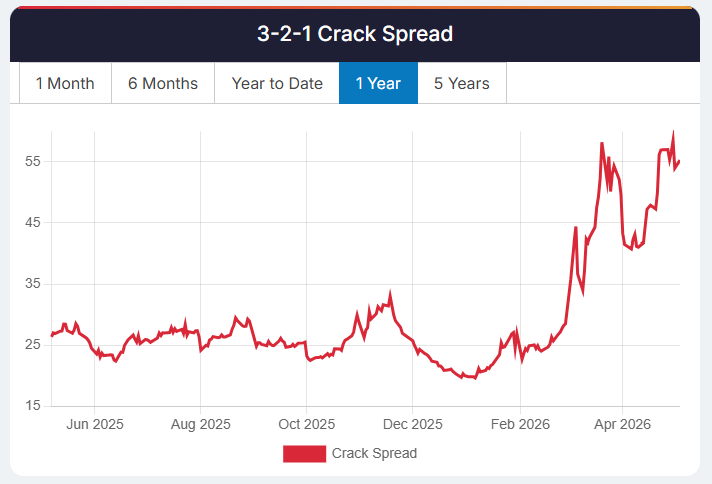
The crack spread defines gross refining profits. The most common metric is the 3-2-1 crack spread, which represents the profit from refining three barrels of crude oil into two barrels of gasoline and one barrel of distillate (diesel and jet) fuel.
The war against Iran caused oil prices to jump higher, but also crack spreads to widen greatly. Here is a one-year crack spread chart from RBN Energy. As I write this, the spread sits at $55.27 per barrel. Yes, for a single barrel of oil.
Valero reported first-quarter results on April 30. Non-GAAP EPS of $4.22 per share beat the Wall Street consensus by $1.06. For the 2025 fourth quarter, the company reported EPS of $3.82 per share.
The rise in crude oil prices and the crack spread didn’t get going until the final month of the first quarter. For the second quarter, Wall Street expected Valero’s profits to more than double, to $9.38 per share.
At $238 per share, VLO trades at 17 times trailing one-year earnings. However, despite gaining 100% over the last year, it trades at just nine times the forward estimate of $28 per share. One thing we do know is that Valero will post monstrous results for the second quarter. For the following quarters, results depend on what happens to oil and fuel prices.
I think MPC and VLO will deliver at least a couple of quarters of strong returns. I also like refiners for the long term, letting our quarterly rebalancing help lock in shorter-term profits.
Portions of this article were written with the assistance of a large language model (LLM). The article has been vetted and edited by the Investors Alley editorial team. Tim Plaehn wrote the investment analysis.
Editor’s Personal Position: Long VLO
Federal Agricultural Mortgage Corporation
Business Overview
The Federal Agricultural Mortgage Corporation (AGM), sometimes known as Farmer Mac, is a stockholder-owned government-sponsored enterprise (GSE) created by Congress in 1988 under the Agricultural Credit Act of 1987. It operates as a secondary market for agricultural and rural loans, similar to Fannie Mae and Freddie Mac in the housing sector. Farmer Mac purchases eligible loans—primarily agricultural real estate mortgages, rural housing loans, USDA-guaranteed portions of agricultural and rural development loans, and rural utility/cooperative loans—from lenders. It then securitizes these assets into mortgage-backed securities, guarantees the timely payment of principal and interest to investors, and provides liquidity back to originators.
Freddie Mac’s core operations span four main business lines: Farm & Ranch (agricultural real estate), USDA Guarantees, Rural Utilities (including power, broadband, and renewable energy), and Institutional Credit. Farmer Mac offers solutions such as direct loan purchases, long-term standby purchase commitments, advances secured by eligible collateral, and risk-management tools that help lenders manage liquidity, capital relief, interest rate risk, and growth. By tapping into the debt capital markets with GSE advantages, it issues securities and debt to fund these activities, ultimately increasing the availability and affordability of long-term credit for farmers, ranchers, rural businesses, homeowners, and infrastructure projects across America.
This structure allows Farmer Mac to replenish lenders’ funds so they can extend more credit while maintaining a focus on safety and soundness, as well as the company’s public mission of supporting rural prosperity.
Investment Considerations
Farmer Mac reported first-quarter earnings on May 5. Non-GAAP EPS of $4.74 per share beat the Wall Street consensus by $0.30. More importantly for us as long-term investors, earnings were up 13% year over year.
The 10-year EPS record for Farmer Mac neatly demonstrates its growth.
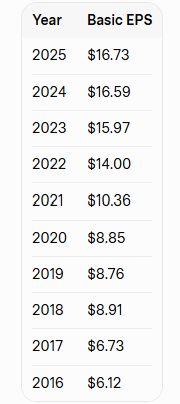
Farmer Mac is a classic dividend growth stock. The five-year and 10-year compounding dividend growth rates were 23% and 13%, respectively.
Over the last two years, dividend growth slowed, increasing by 7% for 2025 and 2026. With a current yield of 3.75%, the yield-plus-dividend-growth formula yields low double-digit total return potential for this stock.
However, the Wall Street crowd estimates AGM will earn $19.76 per share this year, which would represent 18% year-over-year profit growth. We could get a very nice dividend boost at the start of next year.
Portions of this article were written with the assistance of a large language model (LLM). The article has been vetted and edited by the Investors Alley editorial team. Tim Plaehn wrote the investment analysis.
Editor’s Personal Position: Long AGM
CME Group Inc.
Business Overview
Headquartered in Chicago, CME Group Inc. operates as the world’s leading derivatives marketplace. It was formed through mergers and acquisitions, including the 2007 combination of the Chicago Mercantile Exchange (CME) and the Chicago Board of Trade (CBOT), as well as the New York Mercantile Exchange (NYMEX) and the Commodity Exchange (COMEX).
The company runs four designated contract markets that facilitate trading in a vast array of futures and options contracts across major asset classes, including interest rates, equity indexes, foreign exchange, energy, agricultural commodities, and metals.
CME Group’s core business revolves around providing highly liquid platforms for risk management and price discovery. Trading primarily occurs electronically via the CME Globex platform, which operates nearly 24 hours a day and connects participants in about 150 countries.
CME Group also supports cash markets through businesses such as BrokerTec for fixed-income trading (including U.S. Treasuries and repo) and EBS for foreign exchange spot trading. Additionally, it offers over-the-counter (OTC) clearing via CME ClearPort, allowing institutions to mitigate counterparty risk in both listed and customized derivatives.
Beyond trading execution, CME Group generates significant revenue from its integrated clearinghouse services, market data offerings, and ancillary solutions. CME Clearing acts as the central counterparty, guaranteeing performance on trades and providing robust risk management. The company monetizes its ecosystem with fees from execution, clearing, market data (real-time and historical), connectivity, and benchmark/index services. This model supports a global client base of professional traders, financial institutions, corporations, and governments seeking to hedge volatility and optimize portfolios.
Investment Considerations
Since the coronavirus pandemic began in 2020, CME earnings per share have grown by an average of 14% per year.
For the 2026 first quarter, CME reported record net income of $1.9 billion and record EPS of $ 3.36 per share. Year-over-year revenue and earnings were up 14% and 20%, respectively.
CME yields 4%. Dividends have grown by 8% per year for the last five years, and the payout has increased for 15 consecutive years. Over the longer term, CME should produce low-to-mid-teens annual compound investment returns.
Portions of this article were written with the assistance of a large language model (LLM). The article has been vetted and edited by the Investors Alley editorial team. Tim Plaehn wrote the investment analysis.
Editor’s Personal Position: Long CME
Portfolio Update
Dividend Changes
On April 1, Bank OZK (OZK) declared a $0.47/share quarterly dividend, a 2.2% increase from prior dividend of $0.46. This dividend was paid on April 20; ex-dividend was April 13.
Here is a rundown on the current dividend status for each of the Velocity Report portfolio stocks:
Abbvie Inc. (ABBV) declared a $1.73 dividend on February 19. Payment is May 15; ex-dividend was April 15. The current yield is 3.27%.
American Financial Group (AFG) declared a $0.88 dividend on April 1. Payment was April 24; ex-dividend was April 15. The current yield is 5.27%.
Federal Agricultural Mortgage Corp. (AGM) declared a $1.60 dividend on February 20. Payment was March 31. The current yield is 3.68%.
Antero Midstream (AM) declared a $0.225 dividend on April 15. Payment is May 13; ex-dividend was April 29. The current yield is 4.12%.
CME Group Inc. (CME) declared a $1.30 dividend on February 12. Payment was March 26. The current yield is 3.94%.
EQT Corporation (EQT) declared a $0.165 dividend on April 14. Payment is June 1; ex-dividend was May 6. The current yield is 1.10%.
Diamondback Energy, Inc (FANG) declared a $1.05 dividend on February 24. Payment was March 12. The current yield is 2.04%.
Fidelity National Financial (FNF) declared a $0.52 dividend on February 20. Payment was March 31. The current yield is 3.98%.
Kodiak Gas Services (KGS) announced a $0.49 dividend on January 29. Payment was February 20. The current yield is 2.89%.
Liberty Energy (LBRT) announced a $0.09 dividend on April 23. Payment is June 18; ex-dividend is June 4. The current yield is 1.07%.
Marathon Petroleum Corp (MPC) declared a $1.00 per share dividend on April 29. Payment is June 10; ex-dividend is May 20. The current yield is 1.61%.
Blue Owl Capital, Inc. (OWL) announced a $0.23 dividend on April 30. Payment is May 27; ex-dividend was May 13. The current yield is 9.23%.
Bank OZK (OZK) announced a $0.47 dividend on April 1. Payment was April 20; ex-dividend was April 13. The current yield is 3.90%.
Royal Gold, Inc (RGLD) declared a $0.475 per share dividend on February 26. Payment was April 16; ex-dividend was April 2. The current yield is 0.81%.
InfraCap Small Cap Income ETF (SCAP) declared a $0.240 monthly dividend on March 27. Payment was March 31. The current yield is 6.96%.
Simon Property Group (SPG) announced a $2.20 dividend on February 2. Payment was March 31. The current yield is 4.32%.
VICI Properties Inc. (VICI) announced a $0.45 dividend on March 5. Payment was April 9. The current yield is 6.16%.
Walmart Inc, (WMT) announced a $0.2475 dividend on February 19. Payment is May 26; ex-dividend was May 8. The current yield is 0.75%.