

Why November 3rd Could Shock Energy Stocks
A good income investment starts with a business that can pay you through changing market conditions. Occasionally, political uncertainty gives us a chance to buy that business at a better price. That is the possibility I am watching as the November 3 midterm election approaches.
My interest is in the companies that produce, transport, process and deliver the energy our economy requires. Together, these assets form what I call the North American Energy Fortress. The investment opportunity comes from owning essential businesses with cash flows that can support dependable shareholder income.
The election could help investors recognize that opportunity. It cannot create it by itself. The companies still need sound finances, productive assets and a sensible purchase price.
Why The Market Can Turn Before Election Day
Investors spend months considering what a new Congress might do to taxes, spending, regulation and infrastructure approvals. When the possible outcomes seem especially wide, they may demand a lower stock price before committing money. As the outcome becomes clearer, some of that discount can disappear.
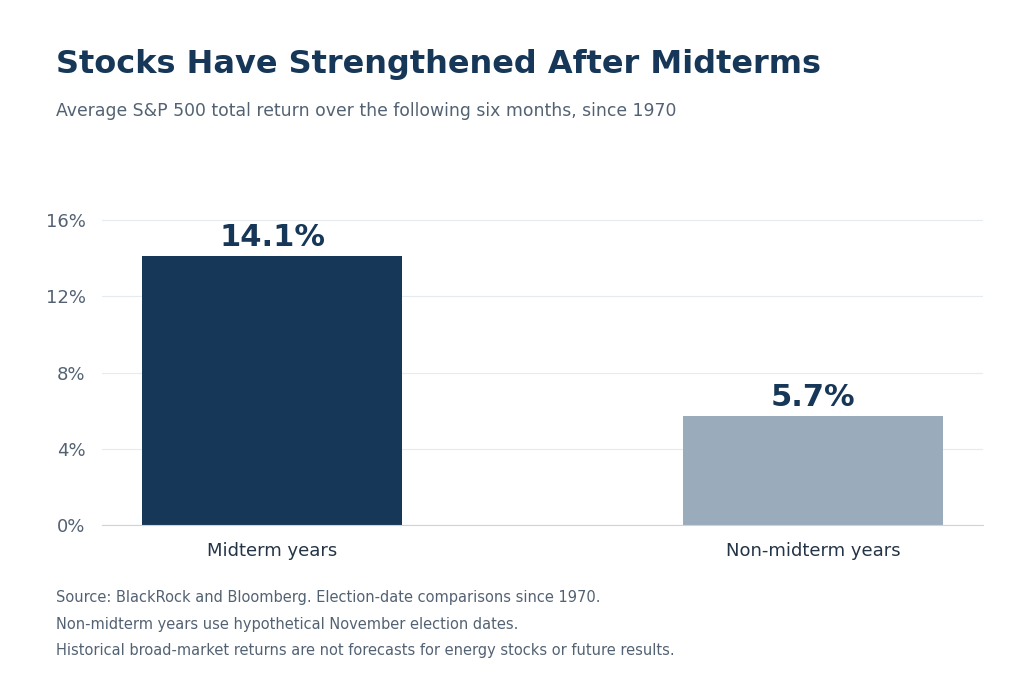
BlackRock finds that, since 1970, the average midterm market rally began about 22 trading days before the election. Its research also reports an average S&P 500 total return of 14.1% during the six months after Election Day. Those are separate observations. The six-month figure does not start at the earlier rally date.
Capital Group reports an average S&P 500 price gain of 15.4% in the year after midterms since 1950, with no negative one-year result in its historical sample covering the 1950 through 2022 elections. That is an encouraging record, but it describes the broad market and a limited number of elections. It does not guarantee a gain in energy stocks or in 2026.
Fidelity strategist Denise Chisholm connects the pattern to changing policy uncertainty. Her research also emphasizes that earnings and business conditions matter more than election timing. That is how I would use this history: as a reason to examine opportunities, while letting the businesses determine what is worth buying.
A Second Chance Requires The Right Price
It is tempting to assume that a midterm year must produce a large buying opportunity. The current year is a useful reminder to be careful. BlackRock reports that U.S. stocks had already gained 13.1% through August 2026. The market has not followed the weak pre-election average in any simple way.
Likewise, a company can have an excellent business and an expensive stock. After a strong advance, some investors may take profits or reduce exposure before the election. If selling develops, we need to determine whether it reflects temporary caution or a real deterioration in the company.
Here is the distinction I care about. A falling share price accompanied by stable cash flow and a well-covered dividend may offer better value. A falling share price accompanied by weakening customers, rising debt and a threatened payout requires a different response. The election calendar cannot turn the second situation into the first.
There is also no assurance that prices will fall before November 3rd. Waiting for a particular date or a perfect entry can leave an investor watching a good business move higher. I would rather establish a reasonable valuation range and act when the shares enter it.
What The 2006 Election Can Teach Us
The 2006 midterms offer a useful example of why political expectations alone make an incomplete investment thesis. Democrats emerged with control of Congress. Yet energy became the best-performing S&P 500 sector in 2007, returning 34.8%, according to a contemporary fund annual report filed with the Securities and Exchange Commission (SEC).
That result does not establish that the election caused the rally, or that a similar outcome would produce a similar return today. Commodity prices and the economic cycle were powerful influences. It does show that a change in congressional control did not prevent energy companies from delivering strong stock-market returns.
I would apply the lesson carefully. We should examine the policies that can affect a particular company, including permits, taxes and export rules. But we should also examine its customers, contracts and earnings. Campaign statements alone tell us very little about the cash a business will generate over the next several years.
For an income investor, the practical question is whether the business can keep paying through different political environments. Existing infrastructure, manageable borrowing and customers who need the service can provide resilience. None makes a company immune to legislation or a recession.
The Energy Fortress Rests on Real Demand
North America has an extensive energy system connecting producing regions with homes, factories, power plants and overseas buyers. The opportunity extends beyond drilling wells. Moving fuel to the customer, generating electricity and maintaining reliable service all require substantial physical assets.
These businesses have different economics. An oil producer is directly exposed to commodity prices. A pipeline operator may receive fees for moving or reserving capacity. A regulated utility earns under a framework overseen by regulators. Understanding those differences is essential before deciding which income stream you want to own.
LNG exports provide one measurable source of demand. In its October outlook, the U.S. Energy Information Administration forecasts U.S. liquefied natural gas exports averaging 17.6 billion cubic feet per day in 2026 and 18.6 billion in 2027, compared with 15.1 billion in 2025. These are forecasts, subject to operating conditions and project execution.
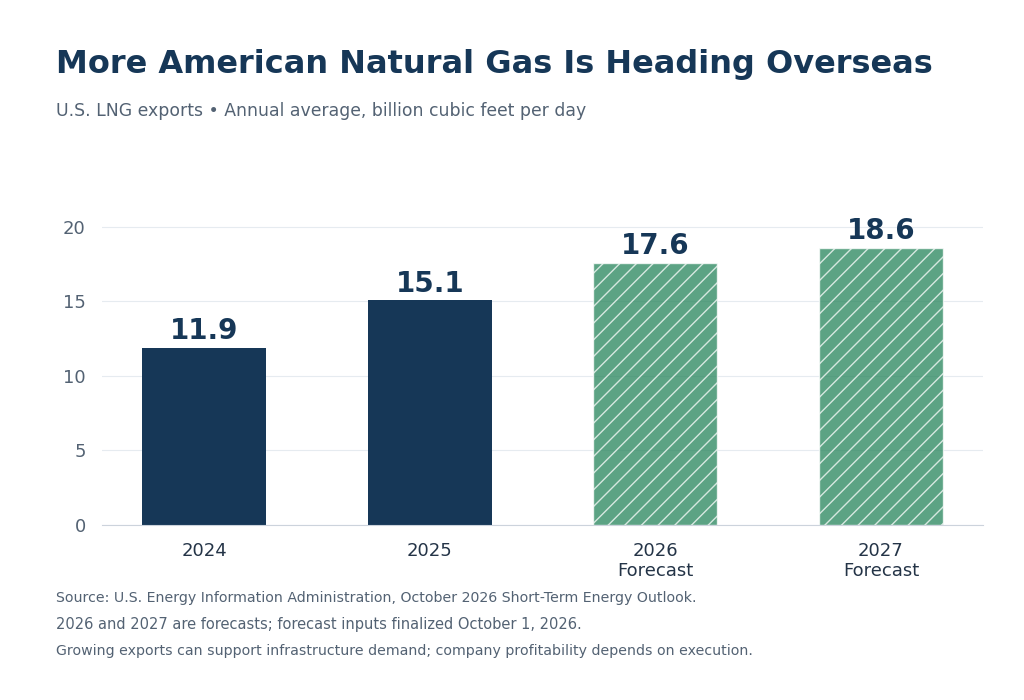
Moving more gas to export facilities can create opportunities along the supply chain. The important company-level questions are whether capacity is needed, customers have committed to paying for it and the expected returns justify construction costs. An announced project is not yet distributable cash flow.
Data centers add another reason to examine electricity infrastructure. The Department of Energy cites updated Lawrence Berkeley National Laboratory research estimating that data centers could account for 11.8% of U.S. electricity consumption by 2030, with scenarios ranging from 9.5% to 15.3%. This is a modeled range, not guaranteed demand.
A data center needs a dependable supply of power. Meeting that requirement can involve generating equipment, transmission lines, substations and fuel delivery. My inference is that investors should study the infrastructure supporting the buildout alongside the technology companies using it. Each proposed investment still needs its own financial case.
More Demand Does Not Guarantee Higher Fuel Prices
Supply matters too. The EIA expects rising production to offset growing LNG exports and forecasts a lower average U.S. natural gas price in 2027. It also forecasts Brent crude averaging $84 next year, below its $105 forecast for the fourth quarter of 2026.
That is why I would avoid building the Energy Fortress thesis entirely around permanently expensive oil or gas. For income, I am particularly interested in businesses whose payments depend on useful services and durable customer commitments. Their contracts deserve close reading, including provisions that leave them exposed to prices, volumes or customer financial trouble.
How I Would Evaluate an Energy Income Purchase
My starting point is the payout. Can the company fund it after paying the expenses needed to maintain its assets? When management presents a cash-flow measure, I want to understand what it excludes. A generous distribution has limited value if the company must repeatedly borrow or issue shares to sustain it.
Next comes the balance sheet. Debt maturities, interest costs and access to financing can determine how well a business handles a difficult period. An attractive project pipeline loses some appeal if financing the projects leaves shareholders carrying too much risk.
Then I examine the source of revenue. Long-term contracts can improve visibility, but their value depends on their terms and the customer’s ability to pay. Minimum-volume commitments, inflation adjustments and renewal dates can matter as much as the headline contract length.
Finally, I compare the price with the income and financial strength I am buying. Consider a hypothetical company paying an unchanged annual dividend of $3 per share. At $50, the yield is 6%. At $45, it is about 6.7%. A $10,000 investment would generate about $600 or $667 a year, respectively, before taxes and costs, assuming fractional shares.
The lower price improves the starting income only if the payout remains sustainable. If a dividend cut is approaching, the higher quoted yield can be misleading. I would rather accept a moderate yield backed by sound finances than reach for the highest number on a screen.
For a purchase that meets those standards, buying in stages can reduce dependence on one entry price. Keep the total energy allocation consistent with the rest of the portfolio. Also check the investment structure: a partnership distribution may involve a Schedule K-1 and different tax treatment from a corporate dividend.
What November 3rd Can Change
The election can clarify congressional control and the likely direction of legislation. Close races or disputes could delay that clarity. Meanwhile, interest rates, commodity supplies, project costs and customer demand will continue affecting energy companies regardless of the vote.
My conclusion is that the midterm pattern gives us a useful reason to pay attention now. If political uncertainty produces lower prices while a company’s cash flow and dividend coverage remain intact, an income investor may receive a better entry into a business with years of useful work ahead of it.
The first advance in an energy stock does not automatically mean the opportunity is gone. It does mean we must be disciplined about what we pay next. I want to own essential assets, collect sustainable income and give well-run businesses time to deliver. November 3 belongs on the calendar. The company’s financial results belong at the center of the investment decision.
What Happens Next
On Tuesday, October 27th we’re going to dive deeper into the opportunity before us. I’ve been analyzing and investing in energy for nearly two decades and I can tell you that right now is one of the few defining moments in energy investing. In my presentation on the 27th we’ll go deep into how we got here and where we’re going, and importantly, how the results of the votes – your votes – on November 3rd will shape energy investing for years to come. Plus, I’ll give you my #1 energy stock FREE, just for attending. Hope to see you there!