


Sell These 7 Dividend Stocks if Clinton Gets Elected
– Tim Plaehn, Editor, The Dividend Hunter
On the campaign trail, Hillary Clinton has promised changes that might radically alter the profitability of traditional dividend growth stock companies if she is elected. That means dividend cuts and plummeting share prices for the seven popular dividend stocks that are revealed below.
In her run to become the next U.S. President, Secretary Hillary Clinton has promised a lot of things to a lot of people. Policies to generate meaningful economic growth is the one area where she seems content with maintaining the status quo of the Obama administration.

My forecast is that with another Clinton presidency, the economy will continue to limp along at just above recession level with GDP growth hovering around ananemic 2% per year. This means a continuation of low interest rates and a probable flattening of the yield curve. A flatter yield curve will be bad news for those financial companies that generate profits off of interest rate spreads, like banks.
The flattening yield curve and a continued slow-growth economy that would be the hallmark of Clinton’s first years as President put these seven high-yield income stocks with highly leveraged portfolios at risk of dividend cuts that will send their stock prices plummeting. The last time treasury yields plummeted was in early 2013, and many of these names lost 30% of their respective share value in quick succession.
High-Yield Finance Real Estate Investment Trusts (mREITs)
The positive Brexit vote in the United Kingdom has turned on its head much of what the financial world was expecting. Rapidly falling bond interest rates have replaced the fears of interest rate increases from the Federal Reserve Board. The record-low rates on the U.S. 10-year Treasury bond will have a very negative effect on one popular type of high-yield income stock. Now is the time to clear these stocks out of your portfolio and add some more stable high-yield dividend payers.
One group of stocks to ditch now are the high-yield finance real estate investment trusts (REITs) that generate cash flow from owning portfolios of federal agency guaranteed mortgage-backed securities (MBS). You will often see this group of companies identified as agency mREITs. Since the government-backed mortgage securities yield only 2% to 3%, these REITs use large (some would say excessive) amounts of leverage to boost the net-yield on their MBS portfolios.
A hypothetical example such as this is the standard in the industry: an mREIT can buy an agency MBS with an average yield of 2.5%. The company can borrow money at 1.0% for a net yield of 1.5% on bonds purchased with borrowed money. The REIT leverages its equity six times to buy a MBS portfolio equal to seven times the equity in the company. As a result, the net yield on equity is 1.5% times the 6 times leverage plus 2.5% on the MBS amount covered by the equity, for a net yield of 11.5% on equity. The equation written out looks like this: (1.5% X 6) + 2.5% = 11.5%.
Out of those net-interest earnings, the REIT must pay management expenses. Also, since both short-term interest rates (the borrowing costs) and long-term rates (MBS yields) fluctuate, the company must invest in interest rate hedges to try to lock in as much of that interest rate spread as possible. MBS pricing can get very complicated as rates change, so hedging is not an exact science. History has shown us that when rates or prices move significantly, hedge trades do not protect ng-term earnings or profits. At best, they keep a company out of bankruptcy court until the markets return to more normal conditions. We all had a taste of this exact situation when the energy markets crashed. Many upstream oil producers with a large portion of their production protected with hedges still did not survive.
With the Brexit vote, long-term interest rates as indicated by government bond yields have declined dramatically. We can use the spread between the 2-year and 10-year U.S. Treasury bonds (Treasury 10-2) as an indicator of what is happening to the spreads earned by agency mREITs.
A year ago, the Treasury 10-2 spread was around 1.75%. Now it has fallen to well under 1%, at about 0.80% as I write this. In just the short period of the 2016 second quarter, for example, the spread dropped from above 1.0%. This means that net interest margins for the mREITs are shrinking rapidly. Remember that all company expenses must be paid out of that margin before dividends can be paid to shareholders. The result will, sooner or later, be large reductions in dividend rates.
To avoid dividend cuts and the resulting share price declines, investors should sell the following agency mREIT stocks:
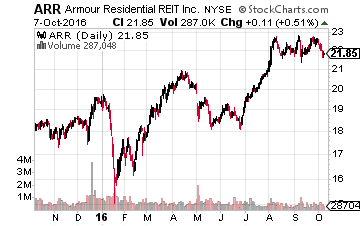 ARMOUR Residential REIT, Inc. (NYSE:ARR) currently yields 1.9%. For the 2016 second quarter, the company reported a net interest margin of 1.37% and a leverage ratio of 7.1 to 1. This finance REIT has already reduced its dividend four times since the start of 2014, and the current dividend rate is 45% lower than what investors were earning at that time. As the net interest margin continues to shrink, the net reduction on cash to pay dividends increases at an expanding rate. A 0.10% decrease has a bigger effect with a 1.4% margin than it did back when the margin was 1.8% in early 2014.
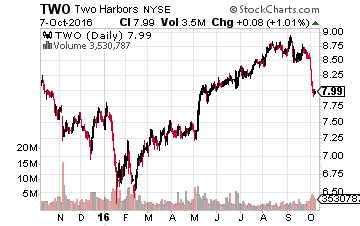 Two Harbors Investment Corp (NYSE:TWO) currently yields 10.4%. For the second quarter, net interest margin on the company’s agency MBS was 2.59% and the company’s leverage was 3.0 times equity. TWO does own non-agency MBS which pay higher yields and are typically not leveraged to the level of an agency MBS portfolio. Recently, Two Harbors invested in mortgage servicing rights (MSRs) in an attempt to boost earnings. MSRs are complicated and the investments have turned into big money losers instead of a new stream of profits. Core earnings for the most recent quarter were less than the current dividend rate.
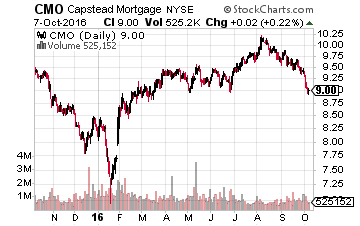 Capstead Mortgage Corporation (NYSE:CMO) currently yields 9.3%. For the 2016 second quarter, the company’s net interest spread was just 0.64%. The quarter’s spread was 25% lower than realized during the first quarter of the year. Leverage was 9.3 times equity, higher than in the first quarter. Capstead Mortgage has already cut its dividend once this year, and the quarterly earnings are significantly lower than the current dividend rate.
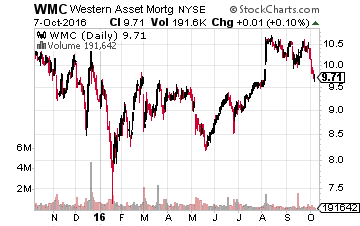 Western Asset Mortgage Capital Corp (NYSE:WMC) yields an eye-popping 18.5%. In the most recent quarter, the company reported a net interest spread of 2.0% and the portfolio was 5.0 times leveraged. Due to some short-term factors, the reported net spread was about 0.5% higher than the company had reported in earlier quarters. Even with the better interest spread results, the net income per share was just enough to cover the current dividend. When interest margins go back to normal, Western Asset Mortgage will not be earning enough to cover the dividend.
Business Development Companies (BDCs)
Business Development Companies, also known as BDCs, are another type of high-yield company where a combination of business and economic factors are putting current dividend rates at risk. Legally, a BDC is a closed-end investment company, similar to closed-end mutual funds (CEF). The difference is that a CEF owns stock shares and bonds, while a BDC makes direct investments into its client companies. A BDC will have up to hundreds of outstanding investments to spread the risk across many small companies. The client companies of a BDC will be corporations that are too small or too new to be able to issue stock or bonds into the publicly traded markets. The business development company business form is tax-advantaged, and these companies do not pay corporate income taxes as long as they pay at least 90% of net income out as dividends to investors.
While the payout requirement does result in attractive yields for investors, there is one big downside for a company operating as a BDC. The majority of loans made by a BDC are high-yield, high-risk investments. There will be defaults from time to time, with average loan losses of 3% to 7% of a portfolio, depending on the overall state of the economy.
Because a BDC must pay out almost all of its income as dividends, there is no provision in the BDC rules to allow a company to set aside loan loss reserves like you’d typically expect with a bank. As a result, over time loan defaults will erode the equity or net asset value per share of any BDC. To offset these built in losses, a BDC must develop strategies to acquire or build equity. This usually involves making equity investments as well as loans, or just operating on a constant cycle of issuing more shares to make more loans. As a result of the equity erosion that is natural to the BDC business model, over half of the approximately 30 publicly traded BDCs have experienced meaningful declines in their net asset values (NAV) per share. These declines must eventually lead to dividend reductions. Here are three BDCs most in danger of reducing their dividend rates:
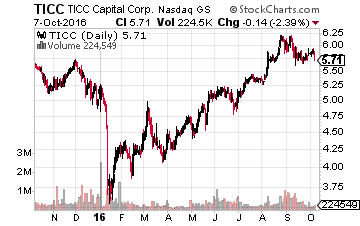 TICC Capital Corp. (Nasdaq:TICC) is a $300 million market cap BDC that has paid the same $0.29 per share quarterly dividend since the middle of 2012. The company invests in syndicated bank loans and purchases debt and equity tranches of collateralized loan obligations. Over the last two years, the TICC NAV per share has dropped by 40%. Wall Street analysts are predicting that future earnings and cash flow will fall well short of the cash needed to sustain the current dividend rate. TICC now yields 18.5%.
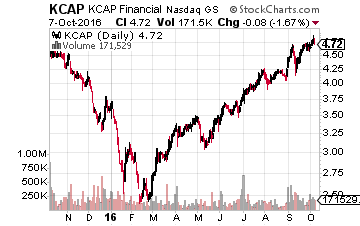 At the end of 2015, $160 million market cap KCAP Financial Inc (Nasdaq:KCAP) reduced its dividend by 28%, down to $0.15 per share per quarter. However, this BDC’s NAV per share has fallen by 29% over the last year and the most recent amount of net investment income was less than the current dividend rate. Another dividend reduction from KCAP at the end of this year appears to be inevitable. This BDC currently yields 13.5%.
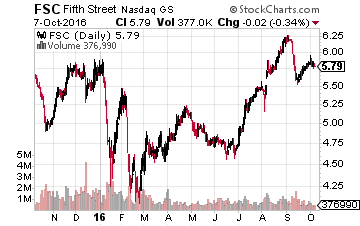 Fifth Street Finance Corp. (Nasdaq:FSC) is a $900 million market value BDC that yields 11.5% and pays monthly dividends, something that is attractive to most income investors. The company provides custom-tailored financing solutions to small and mid-sized companies, primarily in connection with investments by private equity sponsors. The company originates and invests in one-stop financings, first lien, second lien, mezzanine debt and equity co-investments. Most of the FSC financial information looks stable, but the underlying NAV per share declined by almost 10% over the last year. In the case of Fifth Street Finance, the declining NAV may be a leading indicator of a future dividend cut.
Fast Food Stocks
The Clinton administration will push hard for a higher minimum wage. If enacted, a higher minimum wage will be hard on the profit margins of those companies that hire entry level workers. Here is a historically steady dividend growth stock that could be forced to cut dividends or, at the very least, stop announcing dividend increases:
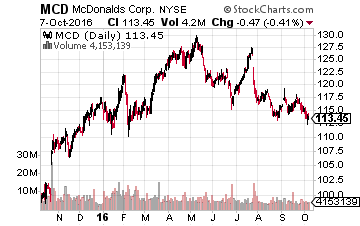 McDonald’s Corporation (NYSE:MCD) has been a strong dividend growth stock, increasing its payments to investors by an average 17.8% per year over the last 10 years. MCD currently yields 3.1%.
Avoiding dividend stocks at high risk of cutting their dividends like the seven above is paramount to investing successfully for income using high-yield stocks. Investors must be extra careful when investing in this type of stock because many of the companies that pay these high yields might not have sufficient cash flow or stable business operation to pay their dividends over the long-term.
Not all dividend stocks will be crushed by a Clinton presidency. In fact, I have a list of high-quality dividend stocks that pay strong yields and are steady performers in any market conditions in my Monthly Dividend Paycheck Calendar that I share with my community of readers. These are the types of stocks you can buy and hold forever and pass down to your grandchildren.
We’ve been using it for a few years now to deliver a steady stream of monthly income for investors using only the safest high-yield stocks. And unlike what the scare mongers out there offer, my Monthly Dividend Paycheck Calendar offers you a real solution whether you’re just looking for extra income or trying to make up for lost time.