
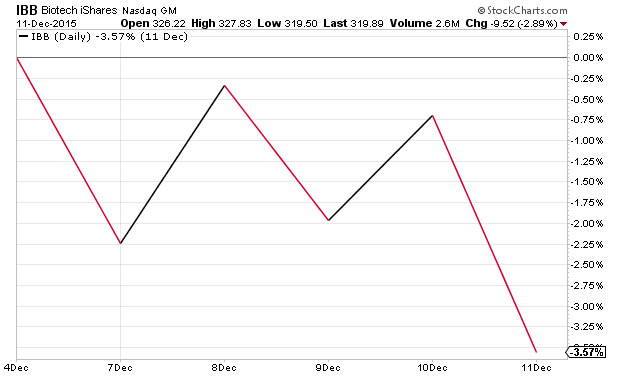
It was one ugly week. After posting an almost 400 point rise on the Dow on Friday, December, 4th thanks to a strong jobs report and favorable comments from the European Central Bank, equities spent most of last week staging deep declines. Concerns around the deteriorating high yield credit markets spread out to other sectors as oil continues to plunge toward $35 a barrel, a seven-year low. The beaten down energy sector saw another seven percent decline this week. High beta sectors like biotech and small caps were creamed as well. Even the Dow Jones Transportation Average saw a deep sell-off even as fuel prices fell further.
The small cap biotech space had its worse week I have seen since probably March of 2014. The sell-off in the overall market triggered by investors switching to a “risk-off” mode hurt this high beta part of the market which also was not helped by failed trials at a variety of smaller concerns that were announced this week. These included Bluebird Bio (NASDAQ: BLU), Agios Pharmaceuticals (NASDAQ: AGIO), Puma Biotechnology (NASDAQ: PBYI), Threshold Pharmaceuticals (NASDAQ: THLD) as well as myriad others.
Keeping Perspective:
It is critical that one keeps a long term view on investing in biotech during times like these. The sector has easily outperformed the overall market during the last decade thanks to the aging of the population in the developed world, an increasing amount of the healthcare dollar going to drugs and treatments, and prices within healthcare rising significantly faster than core inflation. Those factors remain firmly in place and I fully expect this sector to continue to outperform the overall market over the long-term.
That being said, the sector also has much higher volatility than the overall market and tends to have a major sell-off once every 12-18 months and sometimes more frequently. This is why we continue to emphasize that 50% to 75% of your overall biotech holdings should be in our large cap “core” positions. The percentage you keep in these large caps should reflect your own individual risk profile and preferences.
These core positions are much less volatile and are attractively priced as well given their earnings and revenue growth prospects. They also are much more disconnected from macroeconomic factors than most of the market. After all, whether global growth comes in at a tepid 3% next year or a robust 5% has little influence on a company like Gilead’s sales of its HIV and hepatitis C treatments. Worldwide demand levels are critical to most of the rest of the market such as manufacturers, industrials, automakers, agricultural concerns, steel makers, etc…
There are few if any areas of the market that has more fickle sentiment than that of small biotech. The mood seems to shift on this area of the market from euphoria to suicidal every few quarters with little in between those extremes. Lately investors seem to be in the latter mood. However, it is important to remember no matter if these stocks are soaring or down in the dumps at the moment, over the long-term which small developmental concerns do well a year or two down the road is entirely dependent on how well the drugs in its pipeline proceed through trials and hopefully turn into commercialized products. This fact does not change whether the stock currently is soaring or selling off.
Although several of our small developmental stock picks are down substantially since their recommendation, nothing has changed as far as the prospects for their pipelines with the notable exception of Xoma Ltd (NASDAQ: XOMA) whose primary drug candidate did wash out in trials. It is just that early and middle stage developmental concerns in this space are getting pummeled by the market right now. Small caps that have revenues and earnings or are close to FDA approval like Dynavax Technologies (NASDAQ: DVAX) are holding up much, much better.
Performance Update:
The overall biotech sector is down 7.01% since the start of May not accounting for dividends. This is using the iShares Nasdaq Biotechnology ETF (NASDAQ: IBB), the largest ETF focused on the biotech sector with almost $9 billion in assets.
Our large cap core positions in contrast are still holding up well and are down just 1.44% on average while our small cap portion of our portfolio took a significant hit this week and is now down 15.17%, both not including dividends. Using the minimum 50% allocation recommended to our core positions gives us a blended loss of 8.30%, a bit worse than our benchmark. The most conservative allocation of 75% dedicated to the large cap core positions results in a loss of 4.87%, 214 basis points above the benchmark.
Portfolio News:
There was not a whole lot of company specific news this week as the wave of negativity descended on the overall market especially the biotech sector and other high beta parts of the market such as small caps and energy. Early this week I will be reviewing the portfolio to see if it needs to modified in any way before sending out our regular monthly edition of Biotech Gems late in the week.