
Opportunities Coming to “De-Risk” Our Portfolio
The market continues to beat investors with an ugly stick this week and only a huge rally on Friday, including the biggest one-day move in oil in seven years, kept equities from posting much deeper losses on the week. The MCSI All-Country World Index officially went into bear territory this week. The NASDAQ is now down more than 13% just in the first six weeks of the year.
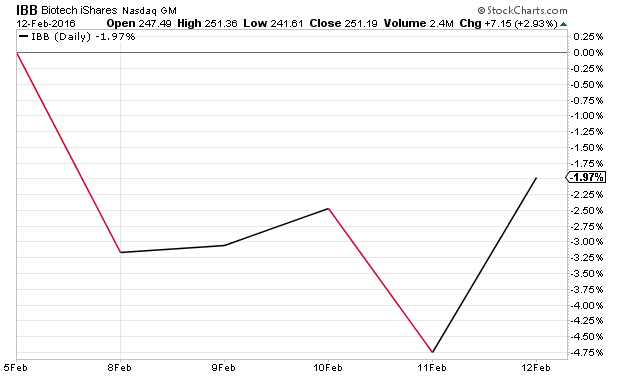
Biotech had its own turmoil with the SPDR Biotech ETF (NYSE: XBI) down at one point intraday during the week more than 50% off from its peak last July. A nice rally on Friday helped to erase a good portion of the losses for the week. Ending on a brighter note, retail sales were better than expected this week and GDPNow is currently forecasting 2.7% growth in the first quarter. It appears the domestic economy is weathering the global turmoil solidly, and maybe stocks can start to find their footing again once we are through earnings season.
Performance Update:
With the continued hit the sector took this week, our benchmark the iShares Nasdaq Biotechnology (NYSE: IBB) ETF, the largest ETF focused on the biotech sector with almost $9 billion in assets is now down 26.98% since we launched the Biotech Gems service at the start of May of 2015.
The divergence between large cap and small cap concerns in the biotech sector continues to widen. Our large cap core positions are now down 11.72% on average while the small cap portion of our portfolio gained more than three percent on the week and is now down 34.28% on average, both not including dividends. Using the minimum 50% allocation recommended to our core positions gives us a blended loss of 23.00%, 398 basis points above our benchmark. The most conservative allocation of 75% dedicated to the large cap core positions results in a loss of 17.36%, 962 basis points above the benchmark.
RELATED: Safeguard Your Money By Creating Your Own “Set It and Forget It” Investment Plan
Portfolio News:
Mylan (NASDAQ: MYL) had a significant sell-off this week because of investors’ reaction to an announced $10 billion acquisition was that the company overpaid for this European purchase. As I noted in an article on SeekingAlpha, after the sell-off, this reaction seems more than a little extreme. The acquisition will be accretive by 35 to 40 cents a share to earnings by FY2017 and gets Mylan into faster-growing emerging markets. I would not be surprised if the shares recapture a decent amount of their decline this week or in the weeks ahead. I raised my stake in this core holding by 25% during this week’s sell-off. The stock is selling at just seven times the profits management just guided to for FY2017 and just over eight times this year’s likely earnings.
Gilead Sciences (NASDAQ: GILD) continues to gain significant strength even in a down market since blowing away earnings estimates on February 2nd. I don’t want to overly optimistic but it sure seems the bottom is in on this core holding.
Portfolio Modifications:
Given the huge downdraft in the biotech sector this year, we will be reviewing opportunities to “de-risk” the portfolio in coming weeks. Almost all small biotechs and biopharma concerns have fallen substantially in this deep bear market. Given this, it makes sense to move the portfolio away from any early or mid-stage developmental concerns and replacing them with positions in small caps that just had drugs approved or just commercialized their first products.
This includes Relypsa (NASDAQ: RLYP) or BioDelivery Sciences (NASDAQ: BDSI) as well as those small caps that have a variety of products on the market like Horizon Pharma (NASDAQ: HZNP). This way we can take some of the “pipeline” risk out of the portfolio while still participating fully in the rally when sentiment on the sector gets less negative. Look for the first of this type of change when the monthly edition of Biotech Gems comes out later this week. It will be the first of several we will make over the month or two to take advantage of much lower prices on shares of companies who have been hit despite little pipeline risk.