
Taking Punches but Ready to Rebound
Equities managed to post a slight gain for the week thanks to a huge rally Friday. This rise was sparked in a large part to a surprise move by the central bank of Japan to try to institute a negative interest rate policy or NIRP. Whether this actually works in the long run is clearly unknown, but for the day investors were thrilled that central banks can provide more support to the market than the long existing ZIRP programs.
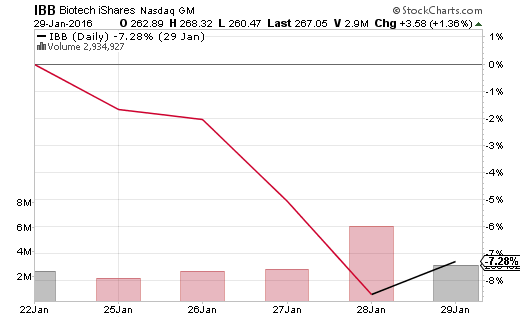
Unfortunately, the biotech sector did not participate in the slight upward trend of the market this week despite better than expected earnings from the larger players in the industry. Presidential politics once again got in the way of any sort of rally and the sector sunk deeper into bear market territory. During the week Hillary Clinton once again tweeted about drug pricing and Bernie Sanders withheld his vote for the new proposed FDA head as he once did some minor consulting work for the dreaded pharma industry.
As I noted in an article entitled “Investing Lessons From Hillarycare” on SeekingAlpha on Friday, investors have seen this sort of silly price action before. Most notably in the early 90s from fears of implementation of a single payer health system dubbed “Hillarycare”. The entire pharma sector lost 30% to 50% of its value while this effort was under way. Once legislation was declared dead, the sector pretty much gained back all of their losses over the next six to twelve months.
If anything, the action since early summer in biotech might be even more irrational. There is no guarantee that either Mrs. Clinton or Mr. Sanders will be the 45th president of the United States when the smoke clears in November. More importantly, the opposition will control the House of Representatives and has a 50/50 chance to retain the Senate. After the Affordable Care Act debacle which is still deeply unpopular, I doubt this rhetoric will turn into any significant legislation that actually has a chance to get passed.
Performance Update:
With the drubbing the sector took this week, our benchmark the iShares Nasdaq Biotechnology ETF (NASDAQ: IBB), the largest ETF focused on the biotech sector with almost $9 billion in assets, is now down 22.37% since we launched the Biotech Gems service at the start of May of 2015. This sector ETF is also down more than 30% from its peak in mid-summer.
Our large cap core positions are now down 5.41% on average while our small cap portion of our portfolio is now down 26.32% on average, both not including dividends. Using the minimum 50% allocation recommended to our core positions gives us a blended loss of 15.87%, 650 basis points above our benchmark. The most conservative allocation of 75% dedicated to the large cap core positions results in a loss of 10.64%, 1,173 basis points above the benchmark.
I know it is less than inspiring to say that our portfolio is taking much less of a beating than that of an investor investing in the major biotech ETFs. However, it is an important edge. I equate the last few months of navigating a putrid market to being a boxer that gets hit hard early in a round and is now on the ropes getting pummeled; hoping to hold on for the next round. He is going to take a beating, but how he takes that punishment will be critical to later rounds.
The key is to take most of the blows to the shoulders and arms and not the jaw. This is why I continue to be obsessive in emphasizing again and again that 50% to 75% of one’s biotech holdings needs to be in those large cap “core” positions, depending on one’s risk preferences. These stocks will always go down less on average than small caps in downturns and usually are the first to recover. This is also the key reason we continue to add distance between our portfolio and that of our benchmark even as we are seeing declines as well. Eventually, this round will end and we will be able to answer the bell for the next round where hopefully we can take it to our opponent, AKA the market.
Portfolio News:
The portfolio news this week revolves around these large cap positions. Both Amgen (NASDAQ: AMGN) and Biogen (NASDAQ: BIIB) reported earnings this week that easily topped both bottom and top line expectations. Biogen bucked the overall downtrend in the biotech sector and ended up for the week. Amgen actually dived down to almost $145.00 a share in early trading Friday after reporting these more than solid numbers after the bell on Thursday. This shows how dismal the sentiment is right now on the biotech sector. By the end of day, however, the shares were trading more than $7.00 a share higher than the lows of the day. I was fortunate to add a few more shares to my core stake at $145.67 a share in early trading Friday.
AbbVie (NYSE: ABBV) reported numbers that were in line with expectations. The shares also initially fell on the report, but by the end of Friday they were pretty much back at the same pre-report levels. Earnings still grew over 25% year-over-year on just better than an 18% gain in revenues. Gilead Sciences (NASDAQ: GILD) was our worst performing large cap holding of the week. The stock was negatively impacted by Merck’s (NYSE: MRK) new entry into the Hepatitis C market, which has been known about and on its way for around three quarters now. The focus was on its lower “list price” and fears of a possible price war in the hepatitis C market.
These fears are overblown. List price rarely has anything to do with what the actual price is after rebates, discounts, and other incentives. The average domestic script for Sovaldi and Harvoni goes for less than half the official “list” price. This is good politics by Merck, but in the end the two treatments will end up similarly priced when things are said and done. Merck is targeting some niche markets within the HCV space like patients with kidney problems or those receiving opioid antagonist therapy to treat their addiction. Analysts believe this new treatment from Merck should reach $2 billion in peak annual sales by 2020. In a market currently seeing more than $20 billion in annual revenues, this will hardly erode Gilead’s commanding market share in the hepatitis C space.
I added a few shares at just under $83.00 a share on Friday. The company reports earnings on February 2nd and I expect them to be solid.