Kinder Morgan Will Continue to Increase, Not Lower Its Debt Load, and That’s a Good Thing!
This article covers Kinder Morgan, Inc, a Dividend Hunter recommendation. The Dividend Hunter subscribers get first look at the article before I will submit it to Seeking Alpha for a broader release. It is my practice to let subscribers first see any articles I write on the newsletter portfolio recommendations.
In one of those periods of investment community confusion, Kinder Morgan Inc. (NYSE:KMI) has been selling off on the back of a couple of recent articles that question the size of KMI’s debt load and whether the company can even survive with the level of debt and lack of cash on the balance sheet. The counter argument to this fear mongering is pretty straight forward, so let’s get going:
Even though Kinder Morgan is no longer officially in the MLP business following last fall’s roll up of Kinder Morgan Energy Partners and El Paso Pipeline Partners, the company continues to operate using the MLP growth model. The core principal of the model is to acquire or build a portfolio of midstream energy assets. The growth is funded with a combination of new equity issuance and new debt. To grow the business means that both the number of shares outstanding and the amount of debt on the balance sheet will continue to increase.
Kinder Morgan does not start a new project until it has locked up both the customers who will use the pipeline, storage facility, terminal, etc., giving the company has a high confidence level on the amount of revenue the new asset will generate. With costs and forecasts revenues in hand, Kinder will only commit to projects that can produce low teens or higher annual rates of return (IRR). Here are the historical returns on Kinder’s various business lines over the 15 years (Source):
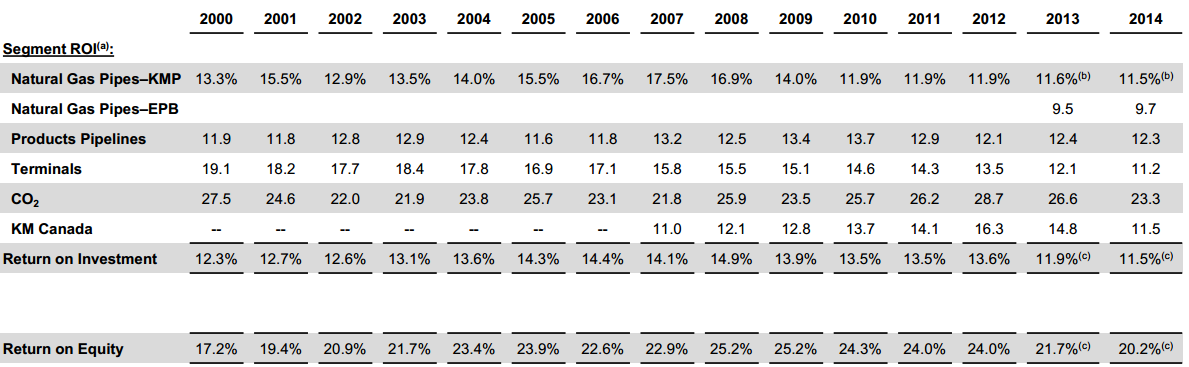
A project will generate those 11% to 15% returns for decades. The funding for a new project will be a combination of new share issuance and debt. Currently KMI shares yield about 5% and the company pays about 5.5% on its long term debt. Kinder Morgan has a 50/50 blended cost of capital of about 5.25% and earns double that when it puts the money to work. Also note on the chart that the combination of debt and equity finance results in 20% plus returns on equity.
Since the business plan is focused on growth through the development of new assets, the amount of debt will never be paid down. Any excess cash flow Kinder Morgan generates will be used to reduce the amount of equity and debt capital required to fund future projects. Any analyst or investor who expects KMI to pay down debt does not understand how the company operates.
With Kinder Morgan Energy Partners, this model operated for almost 20 years, producing a 13% compound annual distribution growth rate. Current KMI expects to grow dividends by 10% per year through 2020. As I covered in my last article on Kinder Morgan, Chairman Rich Kinder is confident that “The Kinder Morgan Game Plan Is Still On Track“. There are few investments that offer a 5% current yield and dividends that are forecast to increase by 2% or more every quarter for the next five years.
A Couple of Points to Understand
I covered above why the KMI debt load will never decrease. The company currently has an $18 billion backlog of future capital expenditure projects. The current $43 billion in debt will be well over $50 billion in another five years. The company’s targeted debt to EBITDA is about 5.5 times. A warning signal would be an increase in the ratio, most likely due to a failure to hit EBITDA guidance.
Net income per share is a useless metric for a company like Kinder Morgan. For example, in Q1 2015 the company reported net income of $469 million or $0.22 per share. However, when calculating distributable or free cash flow, non-cash items such as depreciation, depletion and amortization are added back in. For the quarter KMI’s DCF was $1.24 billion, handily covering the $971 million in dividends paid at $0.48 per share.