

Finding the Next Amazon:
Top 3 Stocks to Buy for 2018
— Tony Daltorio, Editor & Lead Analyst, Growth Stock Advisor
The past few decades have seen the digital revolution change many aspects of our lives. What you and I need to take heed of as investors is that the pace of change is accelerating.
This concept was first brought to the fore by futurist Ray Kurzweil in his book, The Singularity Is Near. He’s a guy you and I should pay attention to. Of his 147 predictions since the 1990s, he has an astounding 86% accuracy rate.
No, he’s not psychic. He just looks at the world a bit differently than most people.
In the book, Kurzweil proposed the law of accelerating returns where technological progress moves ahead at exponential rate. But our human brains tend to extrapolate the future in a linear sense instead of exponentially.
Translation: new and more powerful technologies will be with us sooner than most expect.
In fact, Kurzweil thinks the Singularity – when machines with artificial intelligence (AI) will pass a valid Turing test and therefore achieve human intelligence – will occur in 2029. Others like the visionary leader of Softbank (OTC: SFTBY), Masayoshi Son, think this will happen by 2047.
I don’t know if Kurzweil’s cybernetic future (humans and machines joining) will ever come to pass. But one thing is certain: exponential progress is being made in technology and the rate of advancement is accelerating.
That’s why the Pentagon and some very forward companies have hired science fiction writers to envision for them possible future scenarios. These scenarios range from the grim for the military – “smart” gun being hacked, killing civilians – to the mundane, showing how companies may have to market to artificial intelligences in the future instead of to people directly.
Industrial Singularity
That is the whole idea behind my research project called the Industrial Singularity. There are industries poised to make investors like you accumulate wealth in an exponential fashion. But as with many things in life you have to be in the right places at the right times.
Finding those ‘right places at right times’ is my task in the effort to grow your wealth.
Think about what financial history teaches us. . . . .
There were many breakthrough technologies in the past – electricity, automobiles, airplanes, radio, television. The list could go on and on. The point I want to emphasize is that with all these technologies there were initially a lot of companies involved, making cars or flying passengers, etc.
Here’s just one example – the “Tronics boom”, which went 1959 to 1962.
It was the dawn of the space age and excitement was everywhere, including among investors. Every stock even remotely connected to electronics took off, pardon the pun, like a rocket. The companies had names like Astron, Dutron, Vulcatron, Transitron, Circuitronics, Videotronics and Powertron Ultrasonics.
And one stock was particularly dear to me was Supronics – my parents owned it. But only a precious few electronics companies survived such as RCA (Radio Corporation of America). It too eventually succumbed and was bought by GE in 1986.
Even today, think about how many makers of smartphones have already disappeared. It’s my job to “separate the wheat from the chaff” in the new technologies and make you money. And that’s exactly what I plan to do, using my decades of experience in the investment industry.
Here are just three of those “right places”.
Right Place #1 – Robotics and AI
I believe the first place investors need to be is robotics powered by artificial intelligence.
When many of us think of robots, we still think of Star Wars friendly pair of R2-D2 and C-3PO. Or more darkly, of the dangerous androids from the Terminator movie series.
Well, the future is here and the robots are already among us. Think driverless cars and drones, speech and image recognition software, Amazon’s Alexa and IBM’s Watson.
There are also numerous collaborative robots, known as cobots, that work alongside humans every day in modern manufacturing facilities.
Researchers at MIT found that robot-human teams were about 85% more than productive than either humans or robots alone. The robot technology manager at the Danish Technology Institute, Søren Peter Johansen, says that automating the simplest 80% of a production process is significantly cheaper than a fully automated solution. The remaining 20% of the work will be done by human co-workers.
This teaming up of humans and robots is why forecasts for this niche part of the robot industry call for growth of more than 40% annually over the next five years.
Overall, the consultancy PwC forecasts that AI will add $15.7 trillion to the global economy by 2030.
That’s where you and I want to be as investors – in the best companies involved in a growing sector, reaping exponent gains over that time.
Right Place #2 – Nanotechnologies
Another area of interest has to be nanotechnologies. Nanotechnology is already being used in fields such as:
Medicine – drug delivery as well as diagnostic and therapy techniques.
Electronics – increasing the capabilities of items from circuits to sensors to lasers.
Energy – the battery that will be in your electric car will likely have nanomaterials in it. Solar energy is also benefiting from advances in nanotech solar cells.
Other sectors that could soon benefit from nanotechnologies include: food, pollution control, clothing and leisure goods such as golf clubs.
And don’t be surprised that if tiny 3D-printed batteries, DNA-based computing and cancer-killing nanoparticles are soon reality. Already on the horizon are ‘smart’ contact lenses. Novartis and Google are involved in a joint effort at the moment. And Samsung is also working on it currently.
There are a myriad of other technologies approaching at Kurzweil’s accelerating, exponential rate. I believe you are as excited by all of these new technologies as I am. That’s why I hope you will stick with me on this journey into the future as a Growth Stock Advisor reader.
Right Place #3 – Internet of Things
My final ‘right’ place we need to be is the Internet of Things or more specifically, the Industrial Internet of Things.
The Internet of Things describes a network of soon-to-be many billions of “smart” connected physical objects that in the future will encompass every aspect of our lives. These things will be embedded with sensors, software and connectivity that will allow these machines to collect and exchange data not only about themselves, but other machines, objects, infrastructure and the environment.
By 2025, it is forecast that more 75 billion devices will be connected.
The goal for this huge amount of data generated is to process it into useful actions that can “command and control” objects to improve the quality of our everyday lives. Again, we are already see some of this with how ‘smart’ our homes, appliances and cars have become.
But the Industrial Internet of Things will be more lucrative than consumer IoT.
Of course, robotics will be a big part of the IIoT, but there is whole lot more involved. The falling cost of sensor technology and the ability to use and analyze previously unknown data (big data) promises to transform the manufacturing of everything from bottles to cars to just about everything. That will benefit companies in the semiconductor industry and the companies that enable communications from all these connected devices.
Major industrial companies all over the world are calling it the Fourth Industrial Revolution. General Electric (NYSE: GE) says that, by 2020, revenues generated from the industrial IoT market globally will be about $225 billion. In comparison, GE forecasts the consumer IoT market will only generate about $170 billion by then.
Industrial Internet
The reason behind the growth is simple. IoT sensors in devices constantly gather data, which businesses can crunch using machine learning to discover more about their customers, machines and supply chains. In theory, this should lead to better decisions and more efficiency and profits.
The pace of spending by businesses on IoT varies depending on whose research you read. Technavio believes the market value of the IoT will be $132 billion in 2020. Gartner says more than $440 billion will be spent on IoT in 2020. The Boston Consulting Group forecast that annual spending on IoT will hit nearly $300 billion by 2020. And IDC says global spending on IoT will reach $1.29 trillion in 2020.
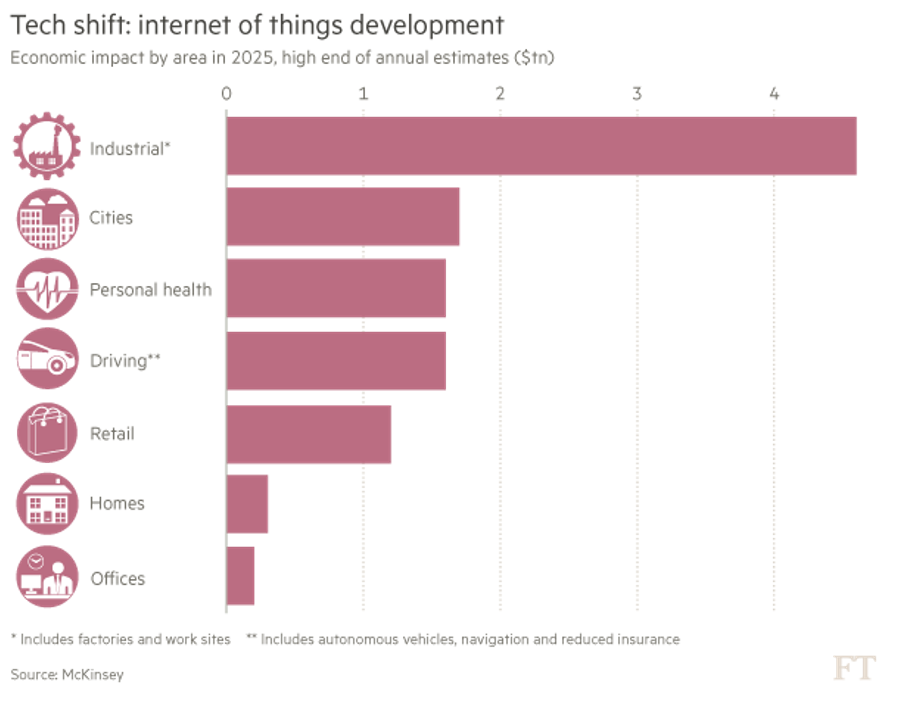
While the numbers vary widely, the takeaway is as Bill Ruh – chief digital officer for General Electric (NYSE: GE) – told the Financial Times, “It’s a huge opportunity for all industrial companies.”
It is also a huge opportunity for the established cloud computing giants like Amazon.com (Nasdaq: AMZN), Microsoft (Nasdaq: MSFT) and Alphabet (Nasdaq: GOOG). They are the biggest providers of Internet of Things platforms.
But I question whether industrial companies will want to become too dependent on the tech companies with whom they may become competitors someday soon. The auto companies are already in a battle with Silicon Valley for future control of the vehicle market.
And I’m sure companies like GE do not like the fact that tech firms are offering predictive maintenance technology that competes directly with its Predix Industrial Internet of Things platform designed specifically to interpret industrial data.
Choosing the Right 3 Stocks
There are a number of ways you can approach investing into the IIoT. Here are just three of them, approaching the future of the Industrial Internet of Things from three different angles.
First, of course, there is more to the Internet of Things story than all the good things. There is the dark underside of having billions of connected “things” – increased hacking and cyberattacks.
This past summer, there was a report about how hackers gained access through an Internet-connected aquarium, which had sensors connected to a PC that regulated tank conditions such as temperature, the amount of food and cleanliness.
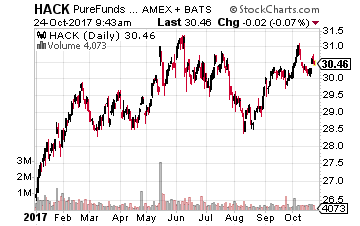 So at the top of my Internet of Things list to buy is something related to cybersecurity. A good, broad-based choice is the ETFMG Prime Cyber Security ETF (NYSE: HACK).The fund’s portfolio consists of 35 stocks and an expense ratio of only 0.60%. The ETF is up nearly 15% year-to-date.
Among the top positions in HACK’s portfolio are leading companies including FireEye (Nasdaq: FEYE), which is currently helping Equifax, Symantec (Nasdaq: SYMC) and Check Point Software Technologies (Nasdaq: CHKP).
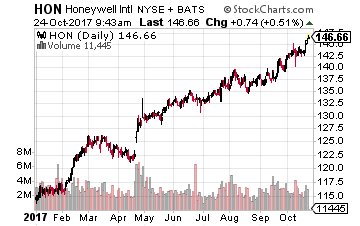
Next on my list is an industrial company that is hitting on all cylinders and a major player in the Industrial Internet of Things – Honeywell International (NYSE: HON). Its stock has climbed about 24% so far in 2017. While Honeywell recently announced the spinoff of its home heating and security business as well as its turbocharger unit, the company currently is divided into four divisions:
 Aerospace (36.5% of revenues) is a major global provider of integrated avionics, engines, systems and service solutions for aircraft manufacturers, airlines, military, space and airport operations.
Performance Materials and Technologies (22.2%) offers technologies and high-performance materials such as hydrocarbon processing technologies, catalysts, adsorbents, equipment and services.
Home and Building Technologies (27.1%) offers environmental and energy solutions, security and fire, and building solutions.
Safety and Productivity Solutions (14.2%) includes sensing & productivity solutions and industrial safety, as well as the recently acquired Intelligrated business, leader in warehouse and supply chain automation.
Specifically related to IIoT, Honeywell offers sensors and automation control products as well as process solutions similar to GE’s Predix. It is also working with companies like Intel (Nasdaq: INTC) to expand its IIoT offerings.
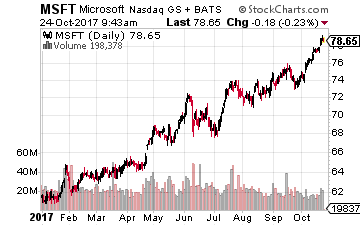 On the technology side, I’d feel comfortable owning another company hitting on all cylinders, Microsoft Corp. (NASDAQ: MSFT). Its stock has jumped 25% so far in 2017.
Its CEO, Satya Nadella, is well on the way to restoring its former glory. As mentioned before, it is a growing powerhouse in cloud computing and is deeply involved in the Internet of Things with its Azure IoT Edge for industrial applications. Its new technology delivers artificial intelligence (AI), machine learning and advanced data analytics via the cloud to local computing devices.
And Microsoft is among the early leaders in field of quantum computing. Nadella describes quantum computing this way in a Financial Times interview: If you think of computing problems as a corn maze, a conventional computer would tackle each possible path, turning back when blocked. A quantum computer will take all the paths at the same time, making even the most complex problem solvable quicker.
Whichever of three paths you choose to invest in the Industrial Internet of Things, I believe, will be a profitable one. But if you’re interested in my top recommendations in the sector, I reveal those in Growth Stock Advisor.
You’ve probably already heard about the Internet of Things, however as we’ve discussed above it’s the Industrial Internet of Things where the real investing opportunities are. Sure, networked fish tanks, baby monitors, and iPhone connected doorbells are interesting, but the truly groundbreaking – and profit making – application of the Internet of Things will happen in industry. In fact, it’s already happening but if you don’t work in a modern factory then you’re probably not witnessing it. And that’s where early investments can pay off… placing where most people aren’t looking and getting in before the Wall Street crowd and financial news organizations start jawboning investors to pile in. And it’s how my readers and I are already making money from our Industrial Internet of Things portfolio.
It’s part of a bigger movement. One that will change how you work, where you live, what you eat, how you communicate, how you get from A to B, even how you sleep. And it will pressure governments and society to adapt quickly or fall by the wayside and risk irrelevance. I call this monumental shift “The Singularity”: the convergence of everything – all driven by the rapid ascent of technology and profit motive.
The Singularity presents investors with the opportunity for a pieces of the over $100 trillion growth over the next seven years. Some of that will derive from the Internet of Things, some from other sectors. That’s why I’m so actively uncovering every investment I can with this space. I’ve recently completed research on The Singularity that lays everything you need to know to get started… the technologies of the future, the pace of change, and the investments you can make right now – today – for a very profitable future. Click here now for access.