
Citigroup Says “Biotech May Not Be Far From Bottom”
The market gave up some of last week’s gains, but a late comeback put the S&P 500 up over one percent by week’s end. The biotech sector posted slight losses with large caps once again performing better than their smaller cap brethren. One big reason for this is that the high-yield credit markets have dried up; this is impacting the ability for small cap developmental companies to access secondary offerings severely. Junk bond issuance in the first two months of the year is down approximately 70% from the year ago period. This has temporarily ratcheted down the valuations investors are willing to pay for small developmental biotech companies with any sort of funding needs. Even ones with newly approved products by the FDA.
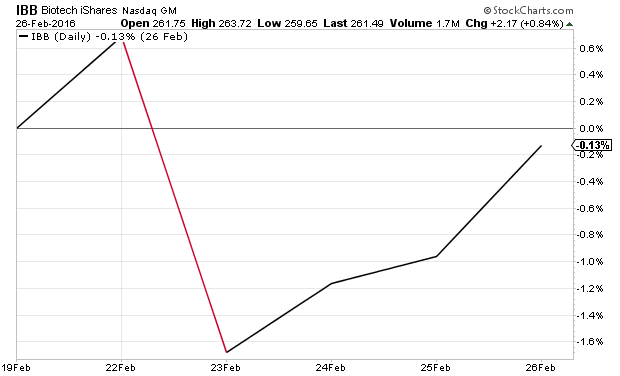
Biotech is still nicely off the lows we hit two weeks ago. It was also encouraging to see Citigroup come out and state the sector is at or near a bottom. Citi is hardly a bull in this market either as they had come out earlier in the year stating they see a 65% chance of recession in the United States this year. Also encouraging is two of their four large cap picks that they see with huge upside, Biogen (NASDAQ: BIIB) and Gilead Sciences (NASDAQ: GILD), are core positions within the Biotech Gems portfolio.
Performance Update:
As stated above, biotech had small losses for the week. Our benchmark the iShares Nasdaq Biotechnology ETF (NASDAQ: IBB), the largest ETF focused on the biotech sector with almost $9 billion in assets, is now down 24.11% since we launched the Biotech Gems service at the start of May of 2015.
Our large cap core positions are now down 7.21% on average while our small cap portion of our portfolio is now down 29.93% on average, both not including dividends. Using the minimum 50% allocation recommended to our core positions gives us a blended loss of 18.57%, 554 basis points above our benchmark. The most conservative allocation of 75% dedicated to the large cap core positions results in a loss of 12.89%, 1122 basis points above the benchmark.
Portfolio News:
Relypsa (NASDAQ: RLYP) had a sell-off after its quarterly report last Wednesday. Initial sales of its new drug Veltassa were very solid and are accelerating as the company gains more reimbursement coverage from the major PBMs and government programs. Investors did have a knee-jerk reaction to comments from management that they will probably have to raise some additional funding to support the rollout of the drug this year.
The market is skittish about any funding needs given the state of the high-yield credit markets, and that is why Relypsa dipped so much even with the strong initial sales numbers. I added a few more shares on the decline. The company has nearly $300 million in cash on the balance sheet and has time to wait for the credit markets to improve before accessing them.
On a brighter note, biopharmas with revenue/earnings growth got some love this week. Mylan (NASDAQ: MYL) had a very solid week and bucked the downtrend in the sector. Eagle Pharmaceuticals (NASDAQ: EGRX) continues to perform very well since being recently added and had another up week. Pacific Biosciences of California (NASDAQ: PACB) after a few tough weeks rebounded almost 10% this week.
Heat Biologics (NASDAQ: HTBX) continues to be one of the most disappointing holdings in the portfolio. The pipeline simply is not developing the way myself and other analysts thought it would by now. The company had to halt a mid-stage trial this week. Unless we see a substantial rebound this week, we will replace this holding in next weekend’s edition as we continue our effort to “de-risk” the portfolio. We want to continue to take advantage of the broad downturn that has been very indiscriminate across the sector since it hit its peak levels in July.
Synthetic Biologics (NYSE: SYN) was the big mover in the portfolio this week. The shares were up more than 30% on not much news outside FBR Capital initiating coverage on the shares with a Buy rating and a whopping $10.00 a share price target during the week. The analyst firm believes the company’s underlying technology could have uses outside of indications they are currently targeting.